


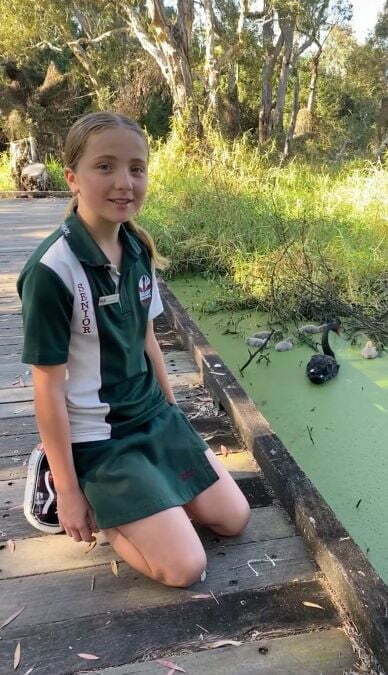
A last-ditch campaign to save Eagleby Wetlands has a new face – a 12-year-old speaking on behalf of future generations.
The state government has approved plans for a highway, the Coomera Connector, to go through the wetlands despite environmental concerns.
The battle now lies in a bid to convince the federal government that the new road contravenes environmental laws.
Until now, the most vocal opposition has come from disgruntled homeowners directly impacted by the proposal, along with passionate community residents who can see strong environmental and social reasons to build the road elsewhere.
But the broken record has been interrupted by a fresh, new and young voice who wants others to see why the wetlands are worth fighting for.
Meet Charlotte Davis. The sixth grader from Eagleby State School was tasked with doing an assignment on a cause important to her.
“It all started when my principal asked us to enter a competition called Children’s Voice, and it asked us to write what’s important to us, and the Eagleby Wetlands are really important to me,” she said.
“I’ve lived in Eagleby my whole life, so I go to the wetlands most weekends.
“I don’t understand how people think it’s a good idea to put so many animals in danger and hurt so many people.”
Instead of just writing something, Ms Davis went the extra mile of recording her presentation at the wetlands, including capturing drone footage.
In it she explained how the proposed connector would affect the environment, paying particular attention to the region’s wildlife.
She finished her presentation by acknowledging new roads are needed to keep up with population growth, but “there has to be a better solution for the Coomera Connector.”
The proposed route through the wetlands was one of seven in total, but the Queensland government said in May that the others were not as effective in terms of supporting the M1 and mitigating environmental impacts.
Ms Davis’ final project made the social media page of the Eagleby Community & Wetlands Group.
“Unassumingly self-confident” is how the group’s spokesperson Marilyn Goodwin described the young lady.
“She was absolutely brilliant,” she said.
Ms Goodwin said the group was so impressed by the presentation that they invited Ms Davis to be a guest speaker at their meeting on Monday, September 6.
“We’re going to be using the video as widely as we can because we think it is really powerful,” she said.
However, Ms Goodwin believes they have a strong argument to get the route changed on environmental grounds.
That could come through an international bird survey starting on September 18 looking at the migratory patterns of the Latham’s snipe, which is believed to inhabit parts of the wetlands.
“They come all along the east coast of Australia to nest and breed through our summer months and then they fly back to Japan, and they’re trying to record numbers because there is concern they are diminishing,” she said.
“Because it is considered to be an important wading bird, and one that the world doesn’t want to lose, to know the numbers are down is almost as important as finding the birds.”