


When the Logan Genealogical Society began in 2001, the now president Robert Thomson wasn’t a member.
Initially the group’s membership numbers were so small the organisation was in danger of closing for good.
Another genealogical group, based in Beenleigh, teamed up to bolster membership numbers and keep the group afloat.
Despite these challenges, Thomson said research was completed and books written by the group’s early members were written from the beginning.
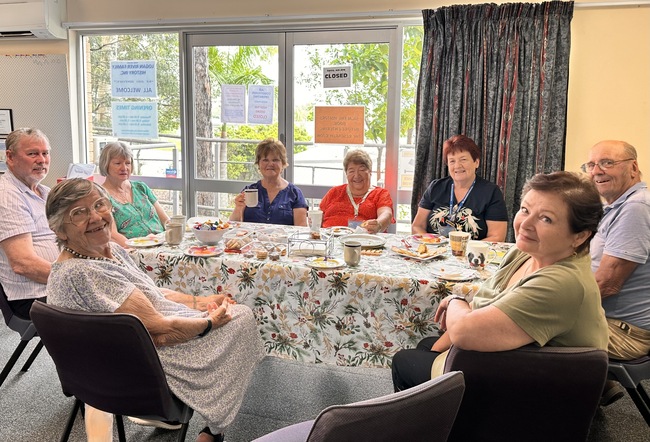
Today the society – renamed the Logan River Family History Inc – has 56 members attending regular sessions investigating their family history at the group’s research rooms, library, and facilities at the Slacks Creek Progress Hall in Springwood.
The society’s research library currently holds over 6700 items, including stories on local families and places.
Fundraising efforts have allowed the group’s facilities to grow.
Mr Thomson said the group, he described as collaborative and welcoming, are always looking for new members.
“We’d like to welcome a lot more people, but our rooms maybe wouldn’t take too many more. That’s the only issue,” he said.
“We think everyone should have knowledge of their past. Without knowing where you’ve come from, it’s hard to really understand where you might be going.
“It’s very interesting to be able to look back and discover things that you didn’t know about your family, where ancestors came from, what they did, what they were like, finding all the pieces that actually fit together to make up the whole picture of your family.
“It is rather addictive once you get into it.”
In the early days the society didn’t have a permanent place to meet and conduct research.
Members would carry around a box filled with research documents and important information in the boot of a car, sometimes meeting at other member’s homes, Mr Thomson said.
The society runs research sessions three times a week on Thursday, Friday and Saturday mornings.
“People just come in and they go about their own research. Or, if they need help, there are more experienced researchers here. They can sit down with them at the computers and help, or we may have records if they’re researching early families from this area,” Mr Thomson said.
“And if people are quite confident with what they are doing, they can be left to themselves. And the more they get used to working here, the more they are left to themselves.”
Through collaborative work and resource pooling the group is also trying to build up a resource base of families who settled in the Logan River area, and around Logan, in the early days.
“We may come to what we refer to as a brick wall in our research, because you gradually go back generation after generation and link everything together, but sometimes there’s just no way to get back to the next generation,” Mr Thomson said.
“You can’t find a birth date or a death date or a marriage or something, and it requires some more.
“We also have a monthly meeting where we have a visiting speaker come to talk to us about either local history or about genealogy in general, about ways of doing research, about using DNA, about using the census, in tracing families.”
Conducting family history research has led to surprising discoveries for many of the society’s members.
One member found that she had an ancestral connection to one of the giants of Ireland.
“One thing that you do find skeletons in your ancestral cupboard when you start doing this,” Mr Thomson said.
Through research into his own family history Mr Thomson has traced his family through Scotland, their journey to Brisbane and Melbourne, and discovered a line of cousins living in New Zealand.
“I’ve got all these Thompson cousins in New Zealand that I knew nothing about,” he said.
For new members thinking of dipping their toes into the family history pool, Mr Thomson said it’s possible to begin with very little knowledge.
“The important thing is to start with what you know at the present time,” he said.
“We just need to look at what they know about their family, maybe to talk to their families about their parents and grandparents.
“Once you’ve got that, then you can start working backwards.”
With perseverance and a bit of luck members have been able to trace their ancestral bloodline back to the thirteen hundreds.
“We want to encourage people who have never done this sort of thing before, or maybe you’ve just thought about it and never got into it,” Mr Thomson said.
“We would also like to encourage people to join who have some expertise and some background in it, because we are not just welcoming new people to it and teaching them how to do it, but we want to build up our own resources.”
For more information visit the Logan River Family History’s website: https://loganriverfh.org.au/