


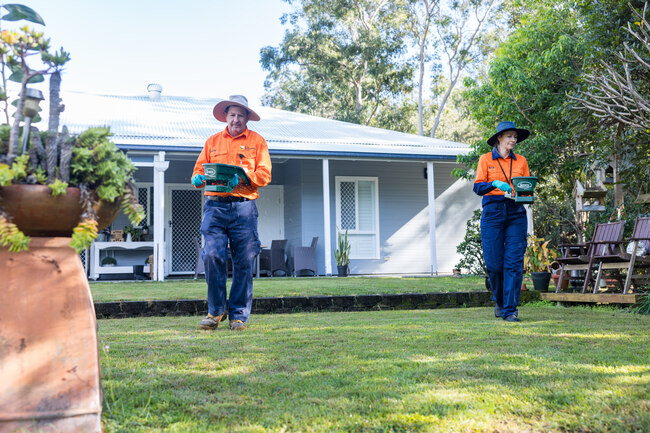
Police will now be helping official fire ant eradication officers gain access to private properties amid fears the deadly pest will cause irreparable damage.
Experts claim arming the community with fire ant treatment is the only way to destroy the pest once and for all.
But eradication efforts only work if everyone pitches in and not everyone is on board.
Some scientists, researchers and policy writers claim many residents are refusing to treat their properties because of apathy, ignorance and a fear of the impacts of the bait.
Now the National Fire Ant Eradication Program will work alongside the Queensland Police
Service to gain access to properties whose owners are obstructing eradication officers from laying “critical” treatment.
Because of the Biosecurity Act, everyone is legally required to help fight fire ants.
General manager of the official eradication program’s strategy and delivery, Marni Manning, said 99 per cent of property owners supported eradication efforts.
“A small minority do not, this group is putting the future of our country at risk, and we cannot stand back and let this happen,” he said.
“Unfortunately, this small group of individuals is actively blocking our teams from treating fire ants.
“They are spreading misinformation about the safety of our treatment approaches and downplaying the potential impacts of fire ants.
“The information they are sharing is incorrect and dangerous.”
Some in the community are concerned the fire ant treatment could post a threat to local wildlife, pets and residents.
But eradication program scientists, along with the country’s regulatory body, disagree.
According to The Australian Pesticides and Veterinary Medicines Authority, fire ant treatment poses no significant risks to people, animals, or the environment when used as directed.
Treatment is made up of small pieces of corn grit – similar the size of couscous –
soaked in soybean oil containing a low concentration of an insect growth regulator.
The ingredients in the treatment, pyriproxyfen and Smethoprene, are not classified as poisons by the Therapeutic Goods (Poisons Standard) Instrument, as both active ingredients have “low toxicity” to humans.
The official eradication program claimed the fire ants posed a “much greater risk” than the treatment, which can now be delivered for free to all properties in Logan.
Residents who report fire ants or nests on their properties will now be sent a free treatment kit by mail.
Mick Jeffery, the director of the Queensland government’s Fire Ant Suppression Taskforce, which funded the $37.1 million initiative, agreed the entire community needed to get involved in fighting fire ants.
“We can’t do it alone,” he said.
“We are confident this new self-treatment approach will protect residents from the devastating impacts of fire ants, reduce infestation levels, and aid national eradication efforts.
“Upon receipt of a suspect ant report, we will dispatch a fast-acting treatment kit that residents can use at the time that suits them.
“Residents should read the instructions carefully and apply the product as directed.”
New research reported by MyCity Logan last week showed almost one Logan resident will die every two years because of a fire ant bite.