


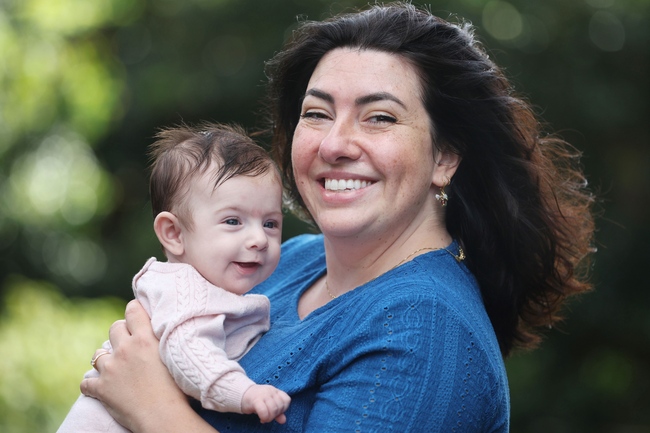
Underwood’s Carol Eckart de Campos almost died giving birth to a daughter doctors said she would never have.
Now, baby Antonia is five months old.
And Ms Eckart de Campos, despite doctors’ warnings and spending 12 days in the intensive care unit, is living her life-long dream.
The 35-year-old experienced a cardiac arrest after delivering her baby daughter via cesarean section at Mater Mothers’ Private Hospital Brisbane in January this year.
She was resuscitated and moved into the ICU.
When she regained consciousness, Ms Eckart de Campos had almost no recollection of what had happened.
However, she remembers her daily visits from Antonia.
“Every day [nurses] brought Antonia across from Mater Mothers’ to see me. The nurses gave me the strength to go through it all,” she said.
The cardiac arrest Ms Eckert de Campos experienced was brought on by a rare but severe congenital heart condition called Transposition of the Great Arteries (TGA).
TGA is where the two main arteries, the aorta and pulmonary, are reversed, changin how blood flows through the body and increasing the risk of cardiac episodes.
Ms Eckert de Campos has lived with the condition all her life. She was diagnosed shortly after she was born, in Brazil.
There is no incidence data available to track the number of TGA cases in Australia, according to Mater Hospital.
Globally, about 9 babies in every 1000 are born with a congenital heart disease, according to the Australian Institute of Health and Welfare.
While working overseas in Germany, Ms Eckert de Campos met her husband, Luke Addati, an engineer and Gold Coast native.
Due to her heart condition and the life-threatening complications pregnancy and childbirth presented, Ms Eckert de Campos was told she would be unable to conceive a child.
“We started to think about adoption or surrogacy and decided to move back to Australia to start our family, but I never gave up hope of having my own baby,” Mrs Eckert de Campos said.
The couple settled in Logan, where they learned that a woman, also diagnosed with TGA, had given birth at Mater Mothers Hospital.
Associate Professor Jo Laurie, Mater’s Clinical Director of Obstetrics Medicine, said medical staff advised the two that life-threatening complications during pregnancy or childbirth were likely to occur.
“We counsel women like Carol very clearly about what the risks are and we work with them and their partners to make a decision they are comfortable with,” Ms Laurie said.
“It’s a very important informed consent process, and we acknowledge the strong desire they have to have a child.”
Weighing the risks and their options, the couple decided to fulfill their long-held dreams.
“When I fell pregnant, I was over the moon, but my pregnancy was a tense time,” Ms Eckert de Campos said.
“We knew the risks we were facing and regularly saw the doctors at Mater, but everything seemed to be fine. I didn’t even have morning sickness.”
Antonia was born safely at 38 weeks to the relief of her parents and medical staff.
“It was a magical, beautiful moment. I was exhausted but so happy that my baby was here at last. I thought, ‘Yes, we did it!’” Ms Eckert de Campos said.
Only 12 hours later, medical staff raced to resuscitate Ms Eckerhart de Campos, who was experiencing cardiac arrest.
Ms Eckhart de Campos is not expected to suffer any long-term damage from the episode.
“When I look at Antonia, I cry,” she said.
“I cannot imagine not being here to be her mum. I didn’t bring her into this world to leave her alone.
“Everything has been worth it to have our baby girl, but there will be no more babies now.
“We would love to adopt another child, but that will be another journey.”