


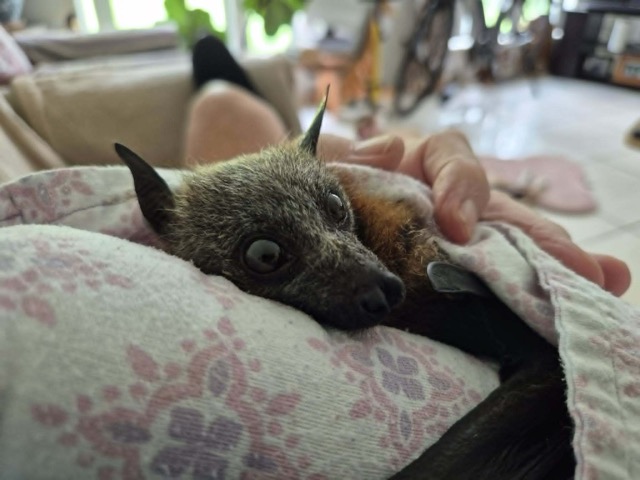
The Queensland Government’s decision to allow the continued shooting of flying foxes has ignited fierce opposition in the Jimboomba and West Logan areas, with local wildlife rescuers and ecologists warning that the practice is pushing a “federally vulnerable” species to the brink.
While the government maintains that culling is a tightly controlled last resort for Queensland’s fruit growers, critics argue the policy relies on disproven myths and ignores more profitable, humane alternatives such as wildlife-friendly netting.
The renewed anger comes after a local group’s motion to stop the continued shooting of flying foxes was voted down in State Parliament last week.
Wildlife carer David Kenny describes flying foxes as a “keystone species” vital to the Australian landscape.
“Seventy per cent of the eucalyptus trees need to be pollinated at night,” Mr Kenny explains, noting that as the only night pollinators, these mammals are essential for the survival of habitats that support other iconic species like koalas as well as spreading the seeds of native flora.
He said the government was prioritising political interests over environmental science.
The conflict is particularly acute in the Jimboomba area, where species like the Little Red, Black, and the federally threatened Grey-headed flying fox are prominent.
Mr Kenny said the timing of the cull often coincided with the birthing season.
“It’s sickening stuff… [the flying fox pups] starve,” he said.
Ecologist Jasmine Vink, who has more than a decade of experience with the species, argues Queensland is the only place in Australia where a federally threatened species is legally culled in this manner.
“The main issue … is that it doesn’t work and it’s unethical,” Ms Vink said.
She highlighted the “scout bat” myth, where farmers believed they were shooting early arrivals to prevent a colony from following, but Ms Vink said the reality was those early bats were often pregnant or lactating females with higher metabolic needs.
Scientific data suggests the physical reality of the cull is more gruesome than many realise.
Ms Vink cited a New South Wales study of more than 200 shot bats where “not a single one was shot cleanly,” with some surviving for four days after being hit.
A Department of the Environment, Tourism, Science and Innovation spokesperson defended the policy, stating permits to cull flying foxes were heavily restricted.
“This remains a tightly controlled, last resort measure, available to very few growers facing exceptional circumstances,” the spokesperson said.
The department said damage mitigation permits had significantly decreased from 21 in 2017/18 to just six in 2024/25, arguing the practice is necessary because “there is no one-size-fits-all approach” due to varying farm topographies within the region.
However, ecologists point to the state’s own research, such as the report “To Net or Not to Net,” which suggests wildlife-friendly netting can increase farmer profits by 20-100% and pays for itself within five years.
Ms Vink said the government should follow the lead of New South Wales, which outlawed shooting and supported farmers through low-interest loans for netting purchases and provided support during natural events that affect flying foxes.
“If they do have things like weather events or starvation events for flying foxes, which exacerbates their impact on crops, the New South Wales State Government steps in and proactively offers support. That is what we should be looking to do,” she said.
Subscribe to stay up-to-date with news from across Logan. You’ll receive a link to our digital newspaper direct to your inbox each week. It’s free.
Follow MyCity Logan on Facebook and Instagram