


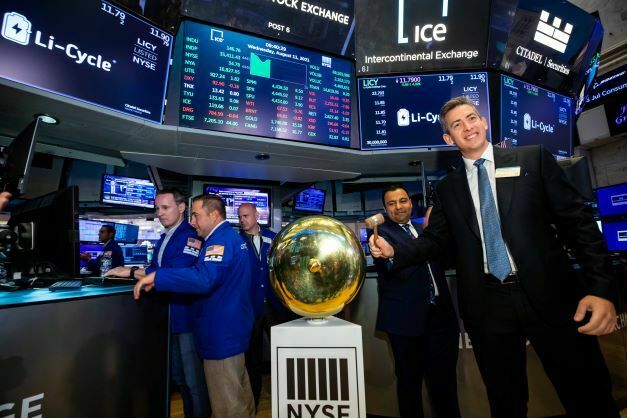
Tim Johnston has come a long way since his days as captain of Windaroo State High School in the early 2000s.
He is now playing a huge part in solving one of the biggest recycling dilemmas of the 21st century to do with lithium-ion batteries.
The company he co-founded four years ago – entirely from scratch – has taken on new heights by hitting the New York Stock Exchange with a market value of $US1.55 billion.
On Wednesday he rang the famous Wall Street bell, signalling a new era for his company on its path to international expansion.
Mr Johnston, from Beenleigh, is the driving force behind the battery recycling business.
Four years ago he cofounded Li-Cycle which is one of the first companies to engineer a method of extracting lithium-ion from used batteries and converting it back into a usable product for battery manufacturers.
Mr Johnston witnessed their first trade on the morning of August 11 in New York.
“Looking around at the team it was a very proud moment, and just fantastic to realise we were able to bring it up to this point,” he said.
That afternoon he joined business partner Ajay Kochlar in ringing the famous Wall Street bell, signalling the close of trade.
“Then in the afternoon we had a ceremony to close the market with some of our executive team, which is quite the experience,” he said.
Getting into the NYSE financed Li-Cycle with roughly $US580 million.
Mr Johnston said this will fund their expansion into North America, Europe and Asia as they build a business plan to enlist new customers.
That could be any company that deals in rechargeable lithium-ion batteries.
Automotive and battery manufacturers are a key focus, as are aggregators such as retail and hardware stores.
For the average person, that could mean sourcing a battery replacement for a power tool, phone or laptop from a local shop that deals batteries from the Li-Cycle system.
This could be part of the answer to a huge recycling problem.
Lithium-ion batteries are too toxic and too much of a fire hazard for landfill, so they must be smelted in costly factories which are poor at preserving metals and bad for the environment.
“This also meant you were losing the lithium,” Mr Johnston said.
With demand for lithium-ion outstripping supply it was critical to find an alternative.
No one – until now – has found a way to extract lithium-ion from used items and repurpose it into new batteries on a commercial scale.
“We break it down to its molecular form and rebuild it and recycle it over and over again without any degradation,” he said.
Mr Johnston is eager to bring Li-Cycle to Australia even though there are no commercial arrangements yet.
“It’s definitely on our radar as the demand and need for electrification grows in Australia,” he said.
“And of course, with my roots back to Australia we keep a very close eye on the market.”
That is good news for dad Noel Johnston who will hopefully get to see more of his son.
He said Mr Johnston always had a flair for mechanical problem solving, so he is not surprised where he is today.
“He’s always been mechanically minded and creative – into restoring old cars and that sort of thing,” he said.
“He started his first engineering job in Caxton Street at the Barracks in Brisbane, then he went to America, started a lithium mine in Namibia, and started looking into recycling batteries.”