


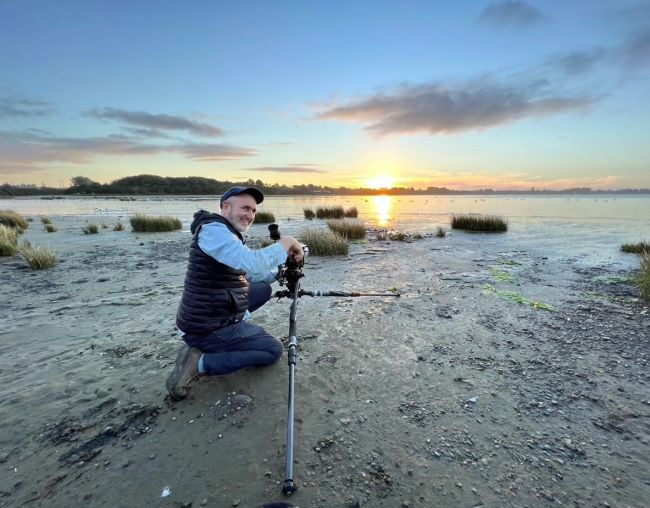
Logan residents have been given an expert-backed excuse to leave the lawnmower in the shed and let their gardens grow wild.
Conservation scientist Hugh Possingham says: “Obsessively mowing lawns is not good for anything”.
“Short grass and scattered trees are not great. Embracing a bit of messiness is always good.”
The BirdLife Australia president and former Queensland chief scientist will explore people’s growing fascination with birds at Logan Art Gallery’s Art and Nature Symposium on Saturday 22 August.
“There would be more species of plants and animals in Logan than in the entire United Kingdom,” Professor Possingham said.
“We are very lucky to have so much diversity.
“But at a local scale, unfortunately, it is in decline.”
He identified habitat clearing, roaming cats and the relentless tidying of gardens and bushland as major threats.
“Big trees are good, dense bushes are good,” he said.
“They give birds cover from predators.”
Residents could help by retaining native vegetation, providing water and planting food trees for species such as glossy black-cockatoos, which depend on native she-oak seeds and large tree hollows.
Containing cats was among the most powerful actions households could take.
“Cats are the only pets we allow to continuously trespass onto other people’s properties,” Professor Possingham said.
“If somebody’s Doberman was wandering the streets, we wouldn’t be happy.
“Roaming cats die, unfortunately. They get run over, they get mauled by dogs, they fight each other and they kill lots and lots of wildlife.”
Professor Possingham said birdwatching had boomed since the COVID-19 pandemic, helped by digital photography and identification apps.
“People love birds and it’s a cheap hobby. It’s healthy,” he said.
“It’s emerging as Australia’s biggest hobby. I think it is going to pass fishing and golf.”
South-East Queensland was among Australia’s best places to take it up.
“I can walk around the Oxley Creek catchment for three or four hours and find 75 species of bird,” he said.
“That’s 10 per cent of the birds on the entire continent, in the middle of the suburbs.”
Birdwatching also exercised the body and brain through walking, listening, identifying calls, recording sightings and meeting people.
“When you’re focused on what you’re doing, it is a 100 per cent activity,” Professor Possingham said.
“There are so many things moving and so many things calling.”
The symposium runs from 10am to 4pm at Logan Art Gallery. Tickets cost $15 for the morning talks or $20 for the full day, while curator and artist talks are free. There will also be a screening of the film Flyaways, which follows teams of scientists tracking shorebirds during migration.
Bookings are available at loganarts.com.au/symposium.
Subscribe to stay up-to-date with news from across Logan. You’ll receive a link to our digital newspaper direct to your inbox each week. It’s free.
Follow MyCity Logan on Facebook and Instagram