


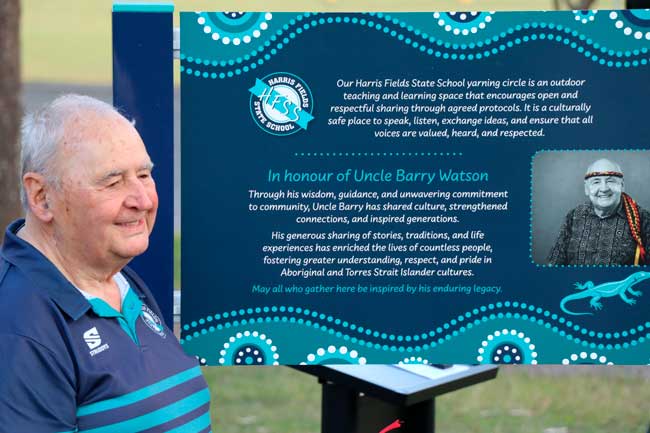
Harris Fields State School has opened a new Yarning circle, dedicated to long time elder-in-residence Uncle Barry Watson.
Harris Fields State School principal Belinda Coulahan said the school’s decision to build a yarning circle stemmed from its commitment to strengthening First Nations presence at the school.
“We wanted to establish welcoming space where we can come together to listen, learn, share stories and build relationships. The development of the yarning circle was a collaborative process and started as an idea three years ago,” she said.
“We envisage that it will be an important learning space for our school community. It encourages not only respectful listening and meaningful conversations but also a deeper understanding of Aboriginal and Torres Strait Islander cultures and perspectives.
“For our broader community, the yarning circle represents belonging, inclusion and our ongoing commitment to reconciliation.”
The yarning circle is dedicated to longtime elder-in-residence Uncle Barry Watson, who has shared his cultural knowledge and guidance to the school community for the past 15 years.
Uncle Barry said he was surprised but very proud to have the yarning circle dedicated to him.
Uncle Barry explained a yarning circle was an ancient way of talking and having a meeting in Aboriginal and Torres Straits Islanders culture, and the school wanted to bring that culture into the modern day classroom.
“It means that everybody who comes to the yarning circle is equal. So whether it’s a teacher and children, principal or staff, everybody comes in at the same level,” Uncle Barry said.
“That’s why the stones are all the same, to learn about respect and honesty, speaking openly and learning to talk in turns.
“The traditional way, Aboriginal people had a stick with emu feathers — which was called a talking stick — and the person who wanted to say something would pick up the stick and hold it and say what they said and then they put it down and the next person would pick it up to reply or to say something else.
“It’s the same in the classroom, the children learn to put their hand up if they want to say something. So that’s the same principle from thousands of years from the yarning circle.”
Uncle Barry said he had been part of the Harris Fields school community for at least 15 years and working two days a week at the school for the past three years.
“I’m also very proud to see that the school won two awards in the last three years for their indigenous work supporting Aboriginal and Torres Strait Islander culture,” Uncle Barry said.
Ms Coulahan said the school community had been excited for the new yarning circle
“The students are excited to learn in the space and have responded positively to having a special place where they can sit together, listen and share,” Ms Coulahan said.
“As a community, we have valued seeing culture represented in such a visible and lasting way within the school.”
The new yarning circle will be used as an outdoor teaching and learning space, and will help to bring Aboriginal and Torres Strait Islander histories, cultures and perspectives into subjects such as english, humanities and social sciences, the arts and science.
The yarning circle will also be used for storytelling, oral language activities, cultural learning, discussions about Country and community, student reflection and conversations with Elders and First Nations community members.
It also provides an appropriate setting for cultural activities and events, including NAIDOC Week and other First Nations programs.
The yarning circle is intended to support cultural learning throughout the year — not only during significant commemorative events.
Harris Fields State School has most recently won the 2024 and 2026 South East Region NAIDOC Barna Jarjum Showcase Award, organised by the South East Region Department of Education.
Subscribe to stay up-to-date with news from across Logan. You’ll receive a link to our digital newspaper direct to your inbox each week. It’s free.
Follow MyCity Logan on Facebook and Instagram