


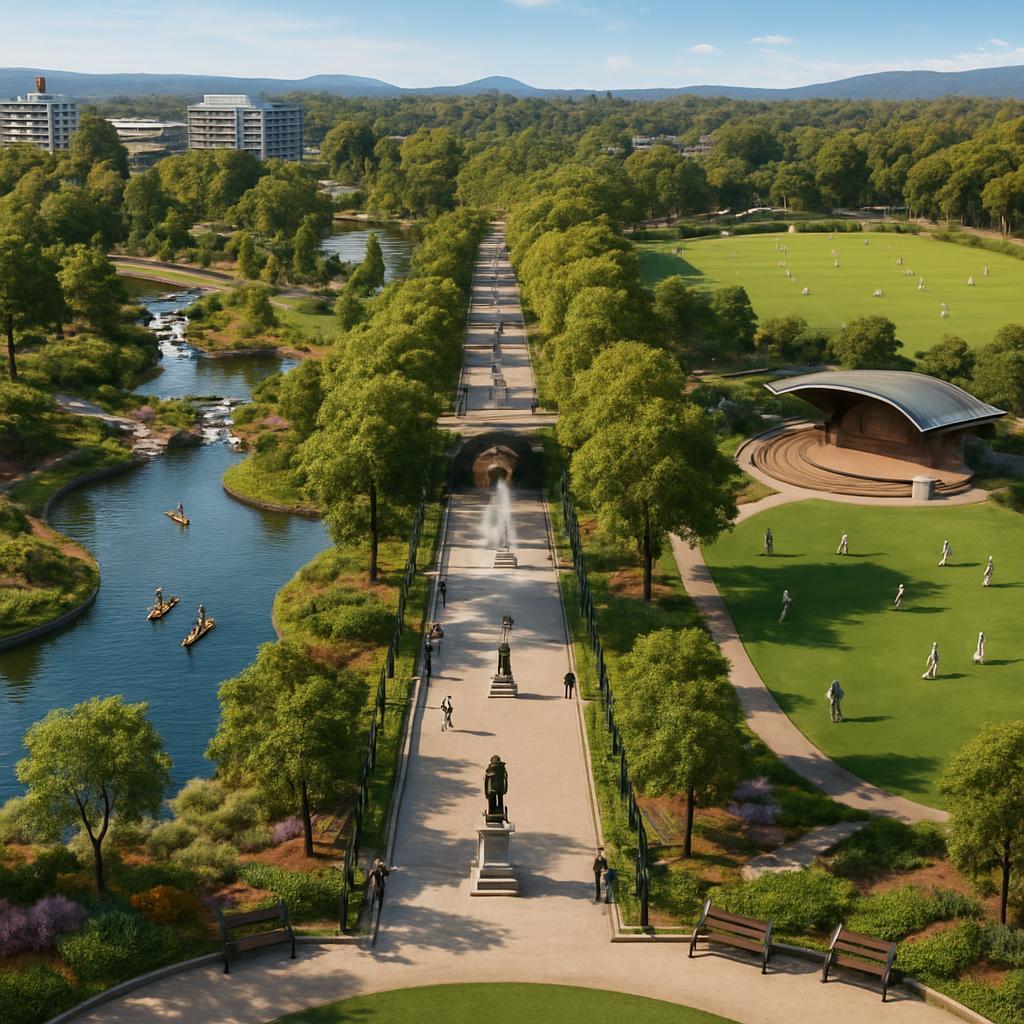
EVEN if you haven’t seen Manhattan’s Central Park in the flesh, you’ve heard about it or seen it in a film, or twenty.
It’s a massive, versatile green refuge that sits on an island densely populated by residents, tourists, traffic, and skyscrapers.
Some of its attractions include the New York City Zoo, the Bethesda Fountain, the Belvedere Castle, the Metropolitan Museum of Art, lakes, meadows, sporting grounds, biking routes; the list goes on and on.
What could a park of similar grandeur and prestige look like for Logan? Which spaces could we activate for the community? What kinds of attractions are we currently missing in Logan that could catapult us to global fame?
In 2024, data collected by the UN Quality of Life initiative, in which Logan is a pilot city, disproved a long-held assumption about how people use parks, said Mayor Jon Raven.
“There’s a long-standing assumption that people go to their nearest park because it’s their most convenient park, but what we saw from the data is that people actually go to their nearest ‘nicest’ park,” he said.
Logan is already awash with green space; the city has over 1000 parks. We are, however, missing a ‘central’ location.
In 50 years, it’s likely that Logan’s population distribution will be different. At the moment, nearly 70% of the Logan residents live in the city’s north. This is expected to change in the next 50 years, with population growth in southern city suburbs like Yarrabilba and Flagstone on track to increase.
“I think it would be wonderful to pick a location that’s reasonably central to the city, and is easy to get to,” Cr Raven said.
“We have two rivers, and that means you can recreate around them, but we don’t really access them very much compared to other cities that have major rivers winding through them.
“It’s convenient because the river literally runs sort of diagonally through the centre of the city.”
Logan River could be activated for a number of water sport activities like paddle boarding, kayaking, and swimming spots to cut down a commute to the beach for a cool off in summer.
“I think we should try to create a point to access the river that’s safe and inviting and then monetise it,” Cr Raven said.
Mountain biking trails through bushland, like the ones at Daisy Hill forest, are another feature that could enhance Logan’s Central Park.
Claudelands Park in Hamilton, New Zealand, adopts a ‘global park’ concept where visitors can enter different parts of the park that look like a ‘themed botanical garden’.
“Locals don’t have to pay to go to that park, but people who don’t live in the city do. That’s a really interesting way of generating income,” Cr Raven said.
Development around the park is almost as important as what is built inside.
Public transport links hold the key to unlocking higher levels of foot traffic, which could have a flow-on effect for businesses located nearby. Building hotels or temporary accommodation around the park’s perimeter could increase tourism levels.
Urban planner and senior lecturer at Griffith University’s School of Engineering, Dr Tony Matthews, said creating a centre of Logan in actuality is a much more difficult task; it will take a complete reimagining of our city in its current form.
“Logan doesn’t really have a centre like Central Park is the centre of Manhattan, which is the centre of New York,” Mr Matthews said.
“Logan’s sort of spatial form, the way it’s organised and the way it’s laid out, is very different.
“You’d have to do a whole kind of re-imagination of Logan as a city, and sort of re-engineer it towards that over the next couple of decades.”
In its current form, Logan has sub-centres, which are essentially areas or suburbs in the city that act as ‘centres’ in lieu of a single centre.
“I think it’s probably unlikely that anybody would try and manufacture a centre at this stage, because we’re kind of Logan is so far down the road of being what we would call decentralised,” Mr Matthews said.
“So instead of one central park, you might end up with five central parks, all smaller, all unique, all connected intrinsically to that particular centre.
“That’s a way you could do it without betting the entire house on a giant Park.”
In reality, a ‘Logan Central Park’ fantasy is riddled with complications; it is difficult to visualise a way to re-engineer the city that wouldn’t change its fabric or be majorly disruptive, and costly.
“It’s harder to reserve engineer it, it’s not about drawing everybody to one location,” Mr Matthews said.
“You could do it, but I just wouldn’t see that there would be an appetite to do it among some of the key decision makers.
“That would be my sort of impression or my suspicion, let’s say.”