


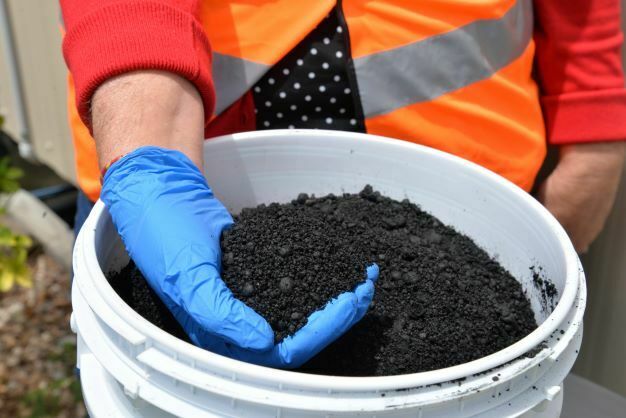
The waste by-product of biochar, created from the city’s waste, is ready to be sold on a commercial scale.
And council has called for expressions of interest from those who might want to buy fertiliser pellets created from the city’s sludge and poop.
Council ran a trial last year to rethink the way waste is used. After refining their processes, they undertook a successful trial last year to convert the city’s waste into a charcoal like substance that can cut waste emissions and be used for fertilisers and building products.
New machinery at the Loganholme wastewater treatment plant can been likened to a big commercial oven, responsible for turning sewage into “biochar”.
The machine reached its final destination at the treatment plant several weeks ago from Germany, following a pilot project to rethink the way the city uses its sewage.
When sewage sludge is cooked at around 600 degrees in a low oxygen environment, it makes biochar, a charcoal-like material that can replace commercial fertilisers, make bricks, pavers, concrete, and asphalt, plus a range of commercial purposes.
“You’re flushing at one end, and at the other end you’re converting it into something that can be used for a lot of good in the building industry and community,” Logan City Councillor Teresa Lane said.
Council bought the oven from a manufacturer in Germany as part of a $28 million project helped in part by a federal grant of $6 million.
The idea came from a dilemma surrounding the use of the city’s treated waste. Large quantities of biosolids being shipped to farming communities contained a high portion of carbon dioxide and chemicals.
“Council currently sends six truckloads of treated waste to the Darling Downs to be used as a soil conditioner every day,” Logan Water Group chief Mike Basterfield said.
Cr Lane said this was when council sought a more efficient and better use for the waste.
The new gasification process will reduce council’s carbon emissions and destroy harmful chemicals such as micro-plastics.
Mr Basterfield said it could reduce the volume of biosolids by 90%, cutting carbon dioxide emissions by 4800 tonnes each year.
The facility will come online by the middle of next year. Expressions of interests to buy biochar close this Friday.