


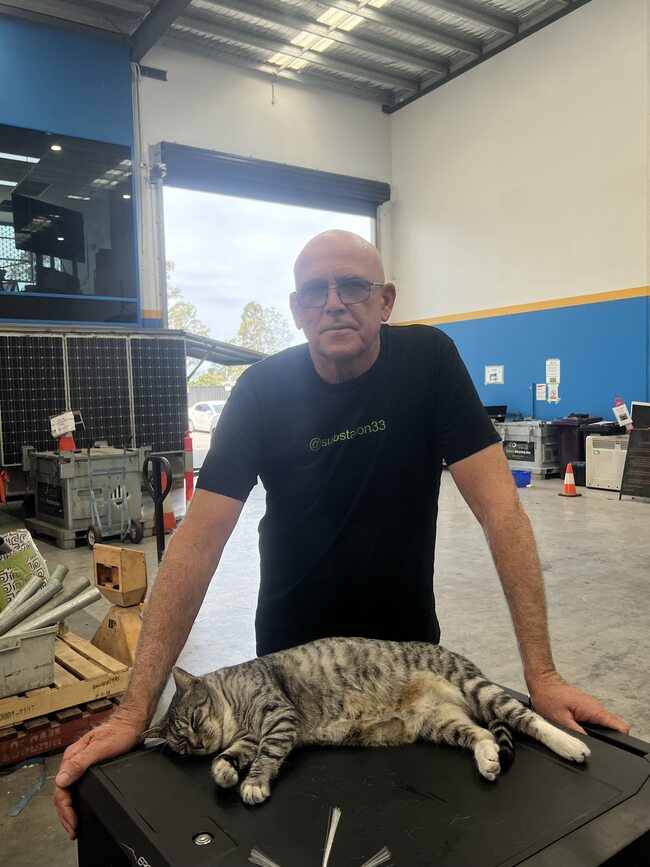
Every centimetre of Substation 33’s two Meadowrook warehouses is being used to push the boundaries of innovation and community through recycling.
In one of the two warehouses, a dozen or so volunteers work quietly through piles of discarded electronics, categorising and then depositing the electronic components into a designated bin.
Desktop computer towers are stripped back to their raw components; cords are untangled and sorted neatly into bundles.
The steady clink of metal and quiet conversations between volunteers fill the space, establishing a rhythm to the workspace.
This is a typical morning at Substation 33.
Founder Tony Sharp moves through the space without ceremony, greeting people as he goes, pausing to check on a task before moving on again.
Substation 33 is both a recycling operation and a social enterprise, though Sharp is quick to downplay any neat definitions.
“We mix environmental work with social work,” Mr Sharp said. “We’re not funded to do this. We do it because we want to make a difference.”
Volunteers can turn up to sort the electronic material as often as they’d like, Mr Sharp said.
“People get stuck into this right here,” Mr Sharp said. “They move it over there, pull it apart, have a conversation, and then get it down to the raw stuff.
“We don’t actually have instructions or a work method statement.”
Underpinning all of Substation 33’s operations is a steady flow of people.
Around 90 staff and up to 600 volunteers each year, all moving through the organisation at different paces.
Some are there for work experience, others are referred through NDIS, WorkCover, or community programs.
Some simply show up looking for something to do.
“People come here because they want to use their hands, learn something, have purpose,” Mr Sharp said.
There’s no single pathway through Substation 33, but there is a structure.
People might begin as volunteers, gradually build confidence, and eventually move into paid roles, either within the organisation or beyond it, Mr Sharp said.
“The skill is participation,” Mr Sharp says. “Turn up on time, come with your best version of yourself, and be willing to learn.”
“For some people, this is as far as they go,” Mr Sharp said. “And that’s okay.”
The next phase, however, is about what comes after.
“The biggest phase for us is what happens at the end,” he says. “When they’re ready to move on.”
Mr Sharp makes his role in all of this seem deliberately loose.
“My job is just to herd the cats,” Mr Sharp says. “I don’t need to know everything. I just need to know enough to make me dangerous.”
That approach reflects his own background.
Mr Sharp grew up in Brisbane, leaving home at 17 to live independently. School, he said, was never a good fit.
“You put me in a room, and I was like a cattle dog at the window trying to get out,” Mr Sharp said.
Instead, he learned by doing; working with his uncles, experimenting with his hands, and figuring things out as he went. An experience, he now tries to replicate for others.
“I want young people to experience work like I did,” he says. “Not perfectly. Just real.”
Before founding Substation 33, Mr Sharp spent years working as a social worker at YFS, a community services organisation in Logan.
It was there he identified a gap: young people who needed work, but didn’t know how to access it or sustain it.
That insight led to the creation of Substation 33 more than a decade ago, initially operating out of a smaller shed in Kingston before relocating to its current site.
Today, the organisation runs seven days a week, often for 12 hours at a time. Recycling operations only pause for 24 hours per year, on Christmas Day.
Mr Sharp is usually there for most of it.
“I was on the phone at one o’clock this morning,” Mr Sharp said. “My phone will still be ringing at seven tonight.”
He shrugs it off.
“I don’t get tired,” Mr Sharp said. “My job is to motivate others.”
Behind the scenes, he credits his partner for making that workload possible.
“She just puts up with my crap,” Mr Sharp said.
Each year, the organisation processes around 200 tonnes of e-waste, with a recovery rate of about 97%.
Much of it comes from public donations, collected by trucks that run five days a week. What can’t be reused is stripped and recycled. What can be salvaged is refurbished and resold, often for a fraction of the usual cost.
Since the COVID-19 pandemic, Substation 33’s refurbishment work has expanded rapidly.
“During that time, I thought, ‘What the hell are we doing, scrapping all this?’” Mr Sharp said.
“Kids were being sent home without devices. They’re trying to do homework on a shared phone between seven people. It was wild.”
Since then, Substation 33 has distributed more than 20,000 devices, priced between $50 and $300, to families, community organisations and support services.
In other sections of the warehouses, Containers for Change employees sort and process crates of cans and bottles.
Nearby, another Substation 33 employee is working on repurposing lithium-ion batteries, salvaging components from electric vehicles to create off-grid power systems.
In an office space on the second floor of the warehouse, staff monitor real-time flood data on a road in Auckland, New Zealand.
Nine years ago, Mr Sharp said he was contacted by councils, locally and across the ditch in New Zealand, with a problem that needed solving.
In response, Substation 33’s team designed and built solar-powered flood warning signs that light up automatically when a road is submerged in flood water, warning local road users.
The organisation now has hundreds of these signs in operation.
“We do everything in-house,” Mr Sharp said. “Design, build, install, monitor, all of it.
“There’s just lots of stuff going on in this little space.”
That constant expansion is intentional. New projects are often driven by the same simple question: what’s needed, and how can it be done here?
“We just get it done,” he says. “Don’t think about it too much. We’ll refine it later.”
There’s little sentimentality in how Mr Sharp talks about his work. He avoids grand statements and prefers to focus on the practical.
Every Friday since Substation 33’s operations opened in 2012, Mr Sharp has facilitated a barbecue for everyone, volunteers, employees and visitors, at the warehouse.
Groups of people in and around the buildings sit together and share lunch. They’ve been there most of the day, quietly working through their tasks.
“They just turn up, do their work, and have a feed together,” Mr Sharp said. “They love it.”
It’s a simple observation, but it captures the essence of the place.
For all its moving parts, the recycling, the engineering, the training programs, Substation 33 runs on something less tangible: routine, purpose, and the opportunity to take part in something that matters.
“It’s just nice,” Mr Sharp said. “Nice for people to have somewhere to come to.”