


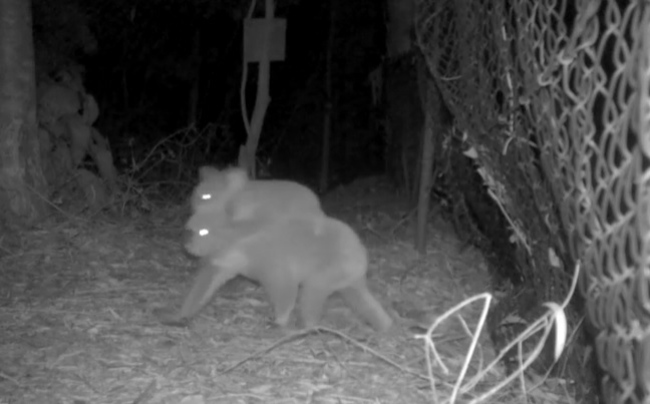
New technology that tells drivers when a koala is crossing the road ahead could soon be used in Logan, helping to prevent the endangered species being hit by cars.
The system uses a camera powered by artificial intelligence linked to a digital road sign to tell road users in real-time when there is a koala crossing the road ahead.
The initiative is led by researchers from Griffith University in partnership with the New South Wales Department of Climate Change, Energy, the Environment and Water.
It is in the prototype phase and was recently trialed by Redlands City Council, successfully detecting a koala crossing on the Redlands Coast.
Griffith University applied transport ecology research fellow Douglas Kerlin said the initiative was part of a strategy to reduce koala road fatalities and support population recovery.
“This new AI technology is going to help us monitor koala movements and it will inform us about road crossing behaviours, allowing us to help slow down the decline in koala habitats,” Dr Kerlin said.
“We have had our first successful detection and recorded a koala crossing a road in real-time on the Redlands Coast.
“This confirms intelligent detection systems can play a critical role in preventing wildlife-vehicle collisions and saving lives.
“We are looking to develop the technology a bit more before we can make it more available across the state, but we are in talks with Logan City Council at the moment and monitoring cameras have been deployed in parts of Logan.”
Dr Kerlin said the AI road crossing signs worked by “sending a real-time signal to the sign when it sees a koala or a person ahead.”
“The artificial technology is trained to discriminate and only identify koalas which are part of a unique fauna group. It will also identify humans,” he said.
“We used to have to employ people to go out there to our camera traps and identify the koala and take down all the information, but now with AI technology it allows us to save time and beams all the information straight to us at Griffith University in an instant.
“We also are working on getting the koalas who have Bluetooth ear tags, hooked up to the signs, so it will send a message directly to the sign saying something like ‘Bubbles the koala ahead please slow down’ and that would be amazing.”
Logan City Council City Planning, Economic Development and Environment Committee chairperson Miriam Stemp said vehicle strikes were the leading cause of koalas needing help in Logan last year, “according to data from RSPCA and Wildcare.”
“The technology could prevent koala injuries and fatalities by prompting drivers to respond when koalas are at greatest risk,” Cr Stemp said.
“Koalas are consistently reported by the community in Bahrs Scrub, Jimboomba, Mt Warren Park, Mundoolun and Slacks Creek.”
“They have been recorded across the City of Logan, moving through parks, along our waterways and through our yards – so we know they are close by, even if we don’t see them all the time.”
Dr Kerlin said research showed dynamic messaging was more effective in influencing drivers to slow down.
“We have had signage similar to the slow down for Sam signs, specifically for koalas for around six years now and our research has shown that those signs have really helped with getting drivers to decrease their speed as they go past,” he said.
“Demographics show if a koala is struck by a car, the slower the car is going the greater the chance of survival.
“These signs will really make a difference and save not only koalas, but driver lives as well.”
Cr Stemp said councils across South-East Queensland were working with Griffith University to support the development of new koala crossing AI technology signs.
“Fauna cameras in the City of Logan, supplied by Griffith University, are feeding into the AI machine learning,” she said.
“We will monitor the results and look at how we could use this technology to improve koala conservation in the City of Logan.”
“We encourage drivers to slow down and look out, especially at dusk and dawn, when koalas are most active.”