


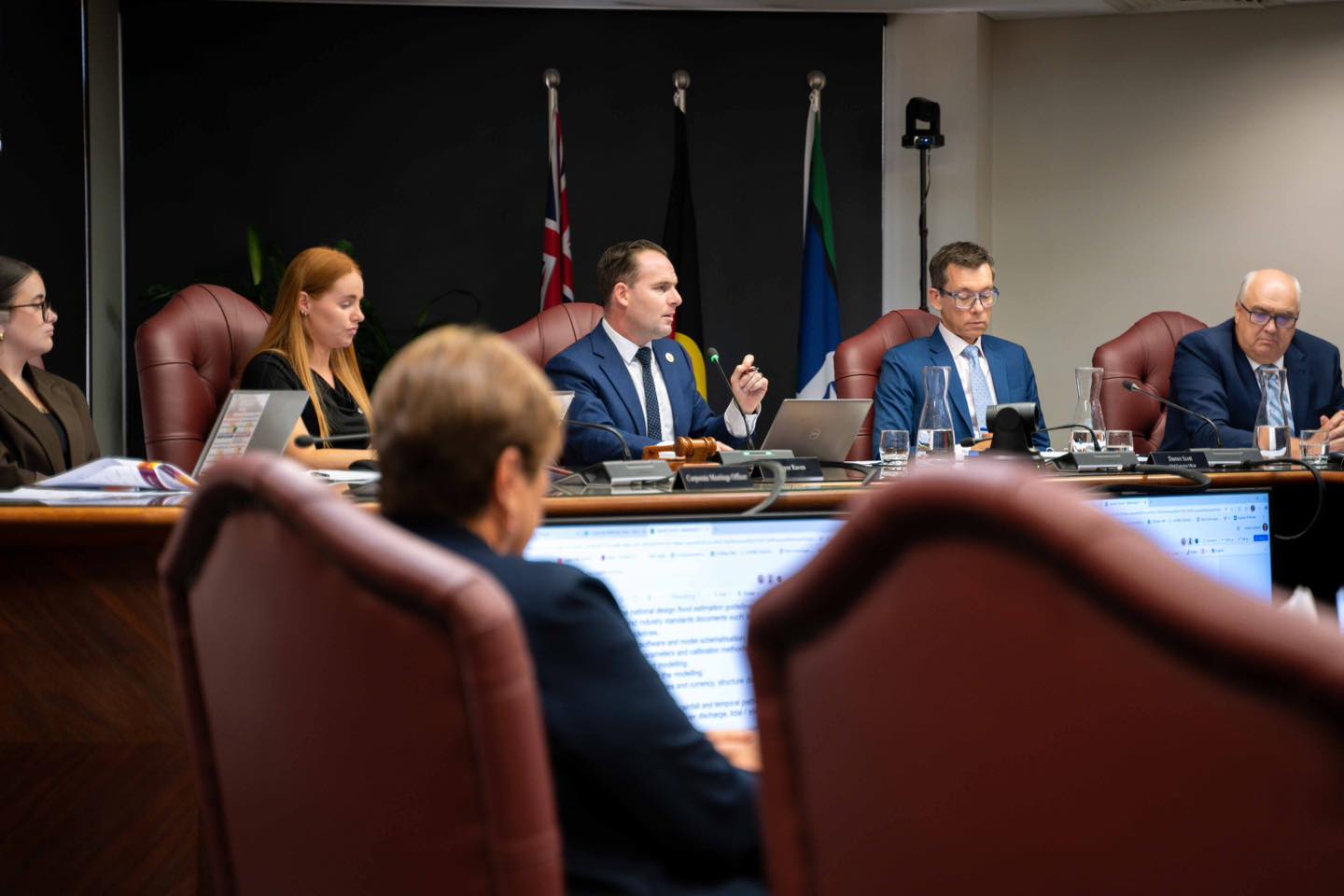
Image: Steven Hoare
THE city’s controversial flood maps will be reviewed yet again.
A majority of councillors have voted for what will be the third review of the mapping process.
City hall-style meetings have seen outrage from residents who claim insurance companies are using mapping as an excuse to hike premiums. They also say property values are threatened.
They’ve claimed there is a lack of recourse for individual property owners, and a lack of rationale for some of the mapping detail.
The third review has been supported by mayor Jon Raven who says residents need to be provided with a system they can trust.
But at least one councillor seems to feel it’s a waste of time, labellng the latest review “smoke and mirrors for political optics”.
The review will employ an “independent” specialist to look at a flood study of the Logan and Albert rivers – one of 11 completed flood studies.
Cr Raven said it would help the council advocate for change to the state government.
With more than 4000 official community responses to the city’s new draft planning scheme – the most submissions in council history – and weeks of online and in-person outrage, council has been hit with a clear message of dissent during a nine-week consultation period.
Under state government orders, the maps must take into account potential future floods – ranging from as frequent as one in 20 years, to one in 2000 years and rarer – to determine which kinds of development can happen , and where.
Some residents and councillors have argued certain ahistorical floods, such as a one-in-2000 year flood, are not realistic and should not be included in the modelling.
The flood maps have been something of a poisoned chalice for the council since 2022 when the Queensland government ordered all local governments to update their planning requirements and flood mapping.
Since then, residents told they are at high-risk of flooding have reported insurance premium hikes reaching tens of thousands of dollars.
Some have been flatly refused cover, and others fear it will impact property rights and value.
While the mapping has already been ‘independently’ reviewed twice, Cr Raven said a more targeted scope would enable the third review to prioritise specific concerns.
“[Residents] asked for this because they do not trust the current mapping compared to their lived experience,” Cr Raven said at a special council meeting on 5 November.
“They are not convinced that it used the correct data. They want to know if there was any ground truthing. They are sceptical that it is fit for purpose.
“They don’t think it is fair to rely on predictions of extreme future flood events.”
Cr Lisa Bradley abstained from voting on a motion to commission the review, which could take six months and cost upwards of $40,000, saying she held “serious reservations”.
“I believe today’s review is smoke and mirrors for political optics… distracting from the possibly inaccurate data and is unlikely to deliver the outcomes many in our community are hoping for,” she said.
Cr Teresa Lane also abstained, saying she didn’t think an additional review would change the outcome for impacted residents.
Cr Mindy Russell abstained, claiming a review was not a solution to the problem.
“I think it is unlikely that our action today will actually change insurance companies’ behaviour. Council does not have that much power,” Cr Russell said at the meeting.
The Logan Flood Mapping Action Group, a grassroots campaign now 6400-strong born in September to advocate for those hardest hit, was also not overly impressed by the review.
Member Adan Warren said the group was grateful the council gave attention to the “real challenges” tens of thousands of local residents were facing.
“But the independent review will not help people because its scope does not address the real issues,” he said.
“The underlying data is flawed and this review does not address it.”
Mr Warren compared it to “baking a cake with the wrong ingredients”.
“You can still follow a recipe but it’ll end up as an ugly mess unsuitable for consumption. When examining the ugly mess, why would you criticise the recipe instead of the ingredients?
“The real problem is obvious. The process and tools could be better – you could use a better oven or improve the ratios, or even try a slightly different recipe, but without correcting the ingredients you will always end up with an ugly mess.”
He said the key issues were around outdated and inconsistent data, limited transparency, and an absence of cracking down on insurance price gouging.
The review is open to expressions of interest from consultants.
Council said there could be reviews of other flood catchments in future.





Another high quality article based on facts, balanced and not outrage. The journalist and media continue to deliver real local news in a manner that is meant to inform truthfully and continues to have our trust.