


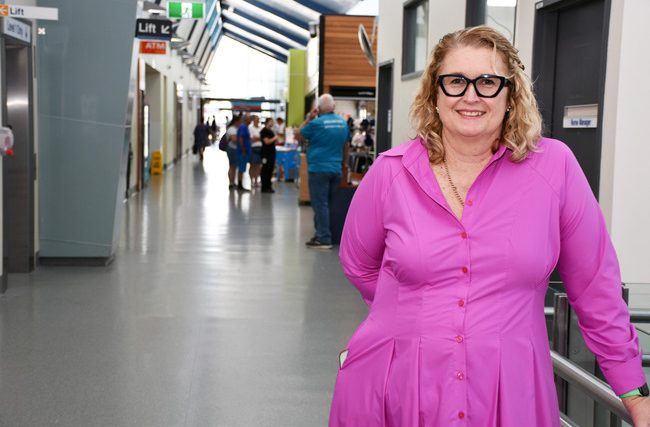
It is one of Queensland’s busiest hospitals amid a health crisis.
It is undergoing one of the largest and most expensive upgrades the state has ever seen.
Combined with thousands of staff and more on the way, managing the day-to-day operations of Logan Hospital is no mean feat.
As the Logan and Beaudesert health service executive director, that’s what Anne Coccetti is paid to do.
She is the matriarch of a large family. A very large family.
While she is a proud mum of six at home – with three children and three pugs – Ms Coccetti looks after 4600 staff and thousands more patients across the region.
But her job isn’t packing lunches and making sure the kids get to school on time. At work, lives are on the line.
The scope of Ms Coccetti’s role isn’t limited to the ‘now’. Her small city is on the rise. And with any small city, there are growing pains.
Hers is a population boom – currently the most rapid of any city in the state.
For the city, it means accommodating 500,000 people by 2036. A 25% increase.
For the hospital, it means a 110% increase in inpatient admissions over the next 15 years, and a 52% rise in emergency department admissions.
So, to cater for that growth, the previous state government invested over $1 billion to expand the hospital.
Once complete, there will be 318 additional beds and treatment spaces across a recently expanded Building 3 and the new Building 4 currently under construction.
Part of preparing for the future also means getting the right people on board.
That is an objective firmly implanted on Ms Coccetti’s mind.
“As you get bigger, you go from being a small hospital where everyone knows each other to a bigger hospital where you don’t know everyone and you have to work a bit harder to keep everyone going in the same direction,” she said.
“But also as you grow, you need a lot more staff, and that has been challenging at times because there are a lot of other areas in Queensland Health that are also growing.”
Ms Coccetti’s role as executive director also covers Beaudesert Hospital, the Eight Mile Plains Satellite Health Centre, and the nurse-led walk-in clinic at Mt Gravatt.
She helps navigate staff and patients between hospitals, clinics and services, ensuring they receive the treatment they need as fast as possible.
“Basically, it’s ensuring the community can access high quality and safe health services when they need them” Ms Coccetti said.
“[I] look after staff from a whole range of different professions and the budget that goes along with that.”
Ms Coccetti isn’t the only female powerhouse in the region’s health service.
This International Women’s Day, 8 March, the Metro South Health Service has a lot to celebrate.
The region’s chief executive is Noelle Cridland, who manages a $3.7 billion budget and more than 20,000 staff.
Its chief operating officer is Paula Foley, medical services director is Susan O’Dwyer, and allied health director is Kellie Stockman – just to name a few.
Ms Coccetti said health was not an industry where being a woman held you back.
Regardless, moving into leadership wasn’t always part of her plan.
But her passion for an egalitarian healthcare system was a fire that always burned inside her.
“I’m from a working class background and so I’ve always been very driven and passionate that people deserve good public health services,” she said.
And the apple didn’t fall far from the tree in the Coccetti household.
Two of Ms Coccetti’s three children work in health.
The third chose a different path, and is studying visual arts at university.
This can make for some fairly interesting dinner table conversations.
“One of my children is a nurse and one is a speech pathologist, and then I’ve got the artist to keep us all in check and stop us talking about health,” Ms Coccetti said
“She realigns us and grounds us to all the other things that happen in the world.”
She said working in a job like she does, although rewarding, required personal downtime.
Ms Coccetti was raised on the Gold Coast.
At university, she studied speech pathology, which she pursued as a career helping people recover from injuries such as strokes.
It was a job she loved.
“You go into jobs in health usually because you want to help people, and I loved helping people be able to get their communication back and return to their life after a life-changing health issue,” Ms Coccetti said.
“But I had the opportunity to go into some service planning and clinical service redesign.
“With those types of things, you could make a bigger impact on a wider scale than you could doing your one-on-one therapy.”
She went on to work in the management of service delivery in northern New South Wales, then at Logan Hospital as the director of allied health before stints as acting executive director of Bayside Health and executive director at Queen Elizabeth II Jubilee Hospital.
She returned to Logan Hospital a little over a year ago.
“I came back to Logan mainly because it’s such a great opportunity with the build and the services that are expanding here.”
Working in any hospital is busy. But working at Logan Hospital is said to be chaos at times.
“We are a busy hospital, I don’t think anyone would argue that,” Ms Coccetti said.
“We’ve got a growing community, so our hospital needs to grow to accommodate and help support that.”
Working in Logan provides Ms Coccetti the opportunity to satisfy that altruistic fire.
Making the lives of staff easier, making the lives of patients easier, and making healthcare more accessible to more people – Ms Coccetti says it’s exciting.
“The community deserves good healthcare, and you want it close to home because that’s the best thing for your family and yourself,” she said.
“This growth is a real opportunity. I’m lucky to be in a job like this where I get to oversee some of that delivered to the community.
“It makes it busy, but busy doesn’t mean awful or difficult. Busy just means you have a lot to do, but it’s a great opportunity to do it.”
Facilitating growth, although just one part of Ms Coccetti’s job, can prove challenging.
“We’re growing at an exponential rate,” Ms Coccetti said.
“How do we attract staff, keep staff, and give staff things to do in their jobs that actually keep them interested and passionate to be here?
“Because ultimately, that gives you the best outcomes for your patients.”
Metro South Health is working with school-based trainees, holding cadetships for people from First Nations backgrounds, and running promotions at universities for graduate positions.
“Targeting those school-age kids and all those adults that are currently at university studying, and giving them opportunities… is helping us with that pathway for having the workforce ready for us in the next couple of years when we need them.”