



Game changing plans to create a second rail corridor in Logan could save thousands of residents stuck without public transport.
But some community members argue that the proposal is progressing too slowly.
Investigations into the development of the Salisbury to Beaudesert passenger rail, which would run through the underserviced west side of Logan, have been in the works for years.
Only now is the Queensland government revealing details of a $20 million business case that has identified heavy rail as the ideal mode of transport and outlined eleven stations.
The proposal would see a train run from Salisbury in the north, south through Hillcrest, Boronia Heights, Greenbank, New Beith, Flagstone and Undullah, through to Gleneagle and then Beaudesert.
The initial phase of study into the project was announced last week.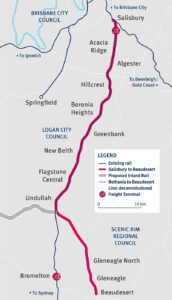
The government said the next phase of investigation would involve protecting the corridor – which included conducting a corridor protection study before community consultation would begin in 2025.
The project study said the analysis of passenger demand showed construction of the rail was “not required in advance of the mid-2030s”.
It also claimed protecting the corridor from encroaching development was an “immediate priority”.
But local resident and independent candidate for Algester, Rhys Bosley, who has a professional background working in transport planning and project management, said protecting the corridor was “long overdue”.
“Unfortunately, due to the government not setting the corridor that has been in the pipeline for a long time, some residents are stressed out because they might be impacted by the project,” Mr Bosley said.
“I think it is very unfortunate that the government has allowed houses to be built early and people don’t know whether or not they are going to lose their house.”
He said the project was “well overdue”, and the rail corridor should have been formally declared “a long time ago”.
“We need public transport because just putting more cars on the road is unsustainable and doesn’t serve the needs of people who don’t have cars,” Mr Bosley said.
“I have listened to residents over the course of the two years I have been campaigning, and I am convinced that a strong majority want the project.”
He said the project should be partially ready – at least the Salisbury to Hillcrest section of rail – by the 2032 Brisbane Olympics.
Transport planning specialist Dr Elliot Fishman, who is the director of the Institute for Sensible Transport, agreed public transport was needed to service the 25 per cent of the population that can’t drive.
He said outer-suburban areas often had “very high levels of car dependence”, with around 90 percent of all trips done by car.
“It’s often the case that the car is three-to-four times quicker than the next fastest mode of transport, so people will often use the car as their default mode,” Dr Fishman said.
“We need to do a much better job of putting housing in places with good transport and improving public transport opportunities in areas that some researchers have described as ‘forced car dependent’ – where people use the car not because they love it, but because there are no viable alternatives.”
He said heavy rail was important, but a focus on urban development around the new train stations was paramount.
“And those train stations need to have a reasonable distance between one another,” he said.
“What we sometimes see in Australia with new rail lines is 3-4km between train stations, and that is a problem because what we get are situations where people live close to a rail line, but far away from a train station and so they still have the same levels of car dependency.
“You need to have fairly frequent stops, and those stops need to have planning zone changes that enable higher-intensity development, so you get lots of people near those train stations to actually use the train.”