


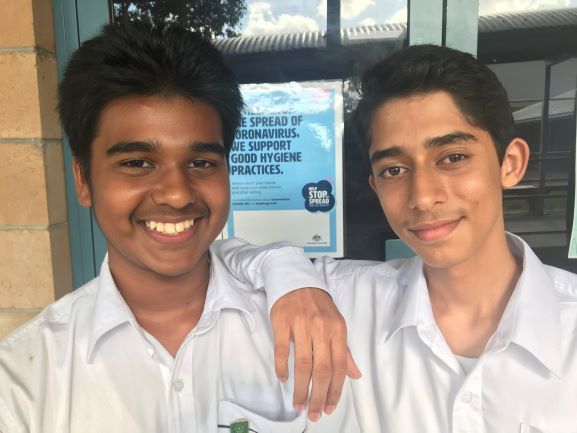
WHEN Abdulla Dawood’s mother knocked on his bedroom door to see if he’d enter a national science competition, she wasn’t quite aware what she had inspired – a tech idea that could change thousands of lives.
Abdullah, aged 14, teamed with Tashfeen Parvej, 13, to create an entry for the annual “Big Ideas” awards.
The pair spoke to a person with cochlear hearing and have devised a bluetooth-driven cochlear implant which sits inside the ear, invisible to anyone else around.
“We wanted to help design something which would allow people with cochlear implants to look like anyone else,” Abdulla said.
The pair spent more than two weeks, day and night, on the project. Teachers allowed them to skip class, their parents allowed them to stay up late.
“We were a bit late to the competition. We thought we had until next year,” Tashfeen said. “So we spent a lot of time on it.”
The result was an idea – like most great ideas – that leaves many wondering why nobody had thought of it earlier.
“We initially thought we could sit the technology on a pair of glasses, but then we thought of putting inside the top of the ear,” Tashfeen said.
The boys are both students at the Islamic College of Brisbane, and with their teacher have won a trip to ANSTO’s Synchrotron in Melbourne, where they’ll spend three days at the largest particle accelerator in the southern hemisphere, talking to the nation’s top scientists, as well as receiving valuable training in design thinking techniques to take their Big Idea and turn it into a reality.
“We haven’t been told what we have to do yet, but we’ll be working on the idea until we get there,” Abdullah said. “We’re both really keen to make a career out of science.”
The prestigious national competition is open to all secondary school students nationally and gives students deep insight into what it’s like to be scientist.
The Big Ideas challenge requires students to investigate a major scientific discovery by an Australian scientist that inspires them, and then take the inspirational work and build on it to create their “Big Idea” that must be about applying science to solve a modern day problem.
To take out the national award, the two Islamic College of Brisbane boys presented their report on Graeme Clark’s Cochear Implant, while pitching their own Big Idea of a new ‘”Nitro Cochlear 2.0″ – invisable tech connected via bluetooth.
ANSTO’s National Education and Engagement Manager, Rod Dowler, said: “Their knowledge and ingenuity are proof the future of scientific discovery and innovation in Australia is in safe hands.”
The Big Ideas experience in Melbourne provides a deep insight into the wonderful opportunities involved in a STEM-based career.
“We know that having interactions with some of Australia’s best scientists and engineers will provide many of the 2021 students with an experience that will change the course of their life,” Mr Dowler said.