


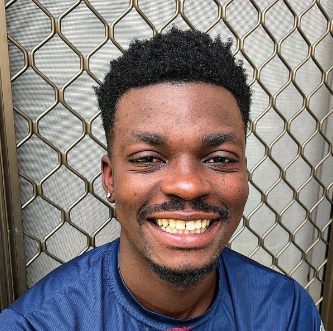
It’s 2005. Tresor Rusangiza was 6, turning 7.
He was playing a game with friends, throwing rocks into squares they’d drawn in the sandy dirt.
“I remember it. It started as a beautiful day, the sky was clear, and we were all playing,” he says of a day that would change his life.
In a flash, there was chaos. A rocket launcher flew over their heads and exploded into a nearby mountain.
The United Nations gathered. For the Congolese, that was bad news. The UN only showed up when things got scary.
“The UN soldiers know things are going to happen before anybody,” Tresor says. “When you see those guys, you know there are going to be bullets. People used to hate them.”
Their suspicions were right. Rebel soldiers stormed the village, caring little for what – or who – got caught in the crossfire. As long as they got their man, whoever that might be, casualties were irrelevant.
Rebels were ruthless. While in the village, they took boys to be part of their army. They took girls for other reasons.
Mr Rusangiza is now 26.
That day, his brother was quick to think, and quick on his feet.
Knowing the consequences would lead to him and Tresor being forced into a militia they knew little about, he grabbed his two youngest siblings, including Tresor’s sister who was just 5.
They ran, and they escaped.
Their mother had already been kidnapped and presumed killed by the Rwandan army. Tresor’s father was a senior soldier under the rule of Joseph-Desire Mobutu which for the Congolese was a prestigious role.
For 60 years, the Democratic Republic of the Congo has been embroiled in stop-start wars, first with its Dutch rulers, and later with its Rwandan and Ugandan neighbours.
It is of course, far more complex than that, but even Tresor’s father’s inherited wealth – including the land on which all his family lived – would not save him from rebels whose only mission was to survive in an environment that cared little for diplomacy.
Tresor’s brother Fiston, 21 at the time, knew the only way to safety was to find a refugee camp.
The only way to do that was to find a trafficker of people, a Zambian who would take the $1700 he’d saved in return for relative freedom.
It took four days for them to walk through jungles to Harare, Zimbabwe, where they would be taken to a refugee camp.
That trip started with 50 people. It finished with 18.
Rebel soldiers had stripped everyone in the group of watches, jewellery, money, shoes, jackets, and in many cases, life.
In an effort to extract hidden money, they executed men at point blank range. The bodies were thrown into the nearby river, food for the waiting crocodiles and hippos.
“The rebels took the girls out,” Tresor says. “If you don’t give us money, we will kill you. Some did get shot. I think about it all the time.
“It was so messed up, they make you watch. It was so bad.
“My sister was crying, crazy. We were barefoot. The mosquitos were biting, Our legs had swelled up. I didn’t tell my brother, but near the river I had tripped over a tree and I my leg was bleeding heavily.
“None of us wanted to upset anyone.”
Tresor carries the physical scar caused that day by the tree. He carries the mental scars of what he saw happen to innocent people in search of the same freedom he and his brother had set out to find.
In Harare, they got lucky. A member of their group who Tresor’s brother had helped by giving money to soldiers, had relations in Harare who could help steer them to a refugee camp.
“I remember that Harare was a city with lots of nice buildings. I thought it would be great,” Tresor says.
“Then we got in a car, 12 people in a car. We drove for 20 hours to a camp in the middle of a wild safari. It was like a zoo, there were animals everywhere.”
The camp was surrounded by an electric fence, moreso to keep the lions and elephants out than it was to keep the people in.
This would be home for six years before a twist of fate.
Call it luck. Call it good management. But if nothing else, it was determination from a sister who’d fled the first Congolese war and ended up in Australia who had discovered siblings were sitting in the Zimbabwe camp.
She set to work, trying to prove she was related to two children she’d never met, and who had no birth papers or identification.
She persisted and the two youngest siblings were allowed to live with her in Brisbane. Tresor sees his brother Finton as his hero, but he knows he is indebted to his sister for her persistence and passion to help family in a time of crisis.
Finton was released from the refugee camp with his wife and two children a year ago, to the United States where Tresor has now visited.
Two years ago, he also managed to talk to his father for the first time since his escape from DPR The Congo.
Six years of playing football in the refugee camp has stood him in good stead. He is now a sport and recreation officer with SSI – what he calls his dream job. And has played 3rd grade soccer for various clubs.
He plays hip hop in a band which has been booked for a number of upcoming gigs.
The memories, he says, haunt him.
He has good friends. Surprisingly, the simple things are what hurt the most: “Being someone who has no parents around, seeing other kids with their parents is what traumatises me the most.
“But I’m okay.”