


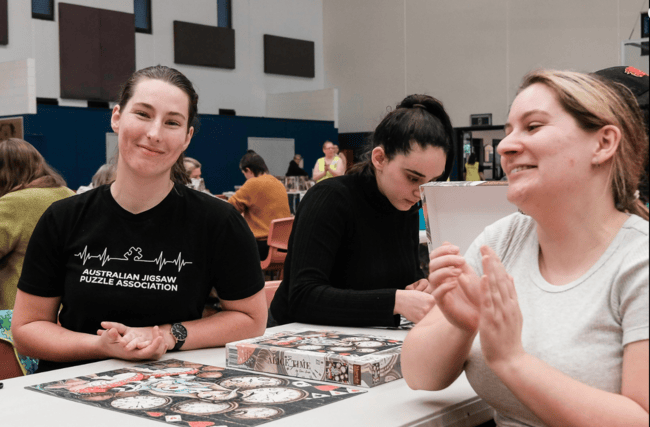
In 2022, Woodhill local Kate Urmston came across a video posted online of a speed puzzling competition, where competitors completed 500-piece puzzles as quickly as they could.
Intrigued, she signed up for a speed puzzling competition in Queensland with a family member.
Competing together as a pair, they placed ninth. Since then, Ms Urmston said she was hooked.
Three years on at 25, Ms Urmston, who works as an assistant chiropractor at her family’s business in Logan Village, is now one of the fastest puzzlers in Australia.
She competes regularly at the state and national levels of puzzling and will compete at the World Jigsaw Puzzle Championship 2025 in Validod, Spain, this September.
“This will be my first year competing internationally, but I’ve competed in all of the national competitions and all except one of the Queensland State comps,” said Ms Urmston.
Last year, at the Queensland state competition, she clocked a time of 55 minutes and 42 seconds, earning her a ranking of fifth in the state.
At the 2024 national competition held in Melbourne, Ms Urmston finished in 11th place with a time of 50 minutes and two seconds.
This year at nationals, she is hoping to finish with a top ten ranking and make it to the final round at worlds.
“My goal is to make it to the finals in each of the rounds at the world championships if I can, which is a big ask.
“In the individual rounds, there are 1800 competitors and only 180 make it to the final.”
To improve her puzzling times, Ms Urmston said she practices completing as many different types of puzzles as quickly as she can.
“The world and national competitions tend to be sponsored by Ravensburger. So getting your hands on Ravensburger puzzles definitely helps, because it allows you to get a feel of the piece shape and the piece fit feeling.
“With an individual puzzle at 90% of the competitions, you’re going to get a 500-piece puzzle, and everyone gets the same puzzle.
“Depending on what event you go to, you can have anywhere between 90 minutes to two to three hours to complete the puzzle, just depending on what level of competition it is in.”
In a pairs event, contestants typically receive a 500-piece puzzle to complete in under two hours, and in a team event, four competitors are given 1000-piece puzzles to complete in two hours or less.
“If I can, I try to compete in all the different events, the individual, the teams, and the pairs.”
The team of puzzlers Ms Urmston will compete with at the World’s in September met at an event hosted by the Australian Social Jigsaw Puzzle Events.
“They put on a lot of puzzle events in South East Queensland that are outside the state competitions, and that’s how we all came together,” said Ms Urmston. “Since then, we’ve been practicing in preparation for worlds.”
Brightly coloured, dynamic puzzles are Ms Urmston’s favourite to complete. Puzzles depicting landscapes with natural greenery, like a field or forest, are much more challenging as pieces are harder to differentiate between.
An approach strategy is important in puzzling circles. Ms Urmston begins by flipping all the puzzle pieces over and pulling out the corner pieces, even if she doesn’t complete the edges first.
Separating pieces with big blocks of colour or patterns that can be grouped together quickly is another strategy for a fast solve time.
“You tend to get locked into the zone, and when you finish and you get a time of 40 or 50 minutes, you’re thinking, ‘Oh, wow, that went really quickly.’”
“When I’m at competitions, I actively have to just keep telling myself, ‘faster’, because once you get over the initial sort of rush of opening the puzzle and flipping the pieces, you can find yourself slowing down a little bit or losing steam.”