


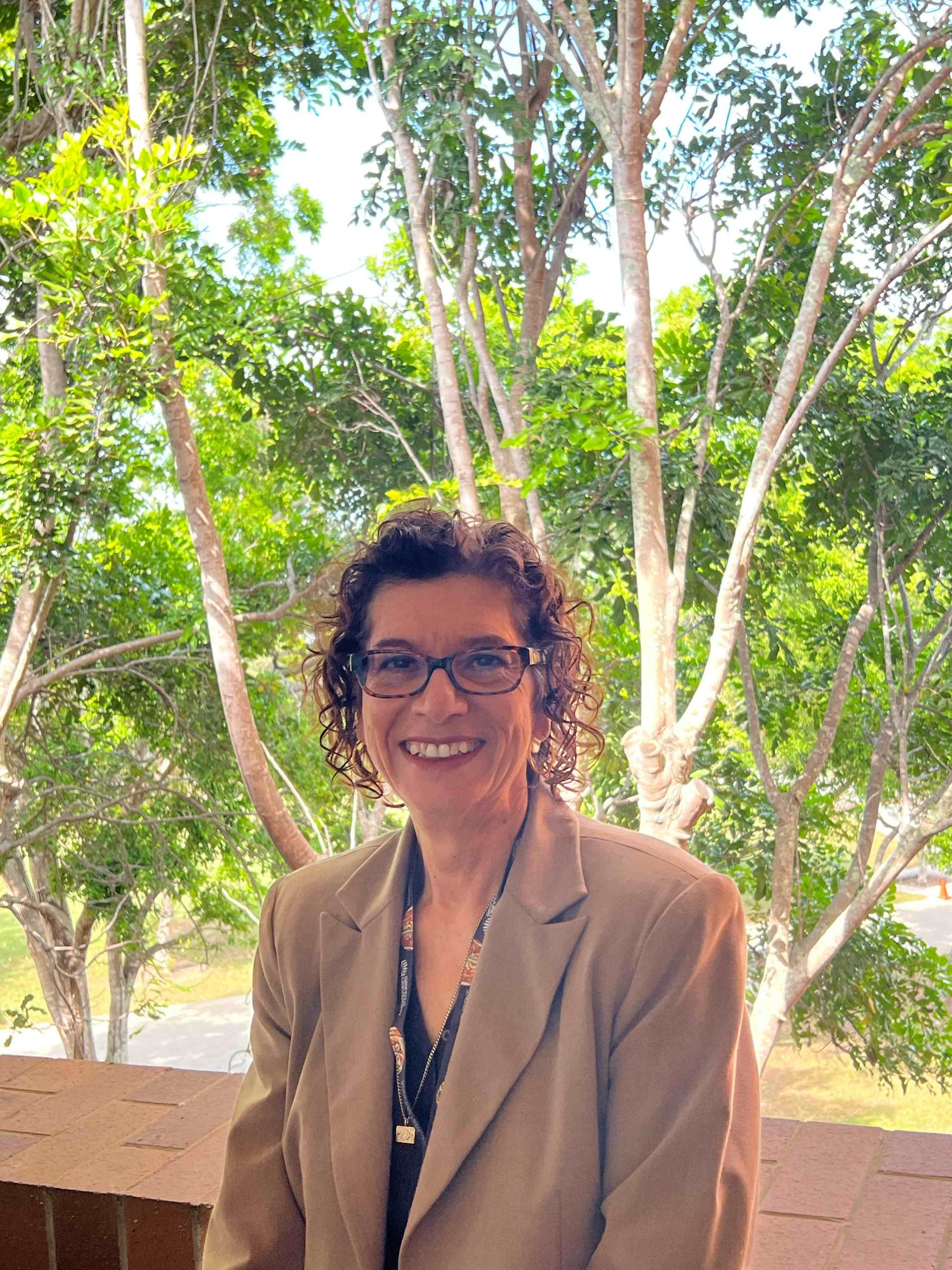
From her office balcony at Griffith University’s Logan campus, Angela Barney-Leitch can see students moving between classes and using the open spaces that stretch toward suburbs she knows well.
Ms Barney-Leitch, who has been the university’s Deputy Vice Chancellor (Indigenous) since February, said she wants the Logan community to feel comfortable using the campus.
“I want the community to own the Logan campus, not the Logan campus own the community,” Ms Bareny Leitch said.
“Come and play pickleball, play soccer or just walk around and have a look at what’s happening.”
A proud Woppaburra Tali Atha woman, the traditional owners of the Keppel Islands off central Queensland, Ms Bareny-Leitch grew up in Woodridge, a few suburbs away from the campus she now leads.
Her upbringing was shaped by the suburb’s close-knit, diverse community, Ms Barney-Leitch said.
“There were so many people from so many different kinds of backgrounds, and we all got along really well,” she said.
“You could always go next door and get a cup of sugar or an egg if you were making something and had run out.”
Community involvement was part of daily life
Ms Barney Leitch’s mother helped establish an Indigenous kindergarten, and Ms Barney-Leitch remembers tutoring younger students and helping raise money for local initiatives while she was still at school.
“What I was really aware of was the volunteer work that a lot of people in the community did,” she said.
At that stage, university was not something Ms Barney-Leitch had considered.
Higher education was not widely encouraged for First Nations students, women or those from low socio-economic backgrounds, and she assumed it was for others.
“At school, teachers had never said to me, ‘Hey, how about you go to uni?’” Ms Barney-Leitch said.
“I didn’t even know where ‘university’ was.”
After finishing school, Ms Barney-Leitch began an apprenticeship before deciding that she would try her hand at university.
“I thought, well, I’ll go and see what happens, and if I don’t like it, I’ll do something else.”
At Griffith, where she completed a Bachelor of Administration and a Master’s of Education (Research) later on, Ms Barney-Leitch often found herself to be the only Indigenous student in her classes.
Sitting in her first lecture, feelings of imposter syndrome settled in, Ms Barney-Leitch said.
“I had these insecurities that everyone else was smarter than I was, and I asked myself, ‘What am I doing here?”
Once those early nerves settled, Ms Barney-Leitch said she realised those fears were unfounded and that, really, she was as smart and capable as her peers were.
She now shares that experience with students who may feel out of place, particularly in their first few weeks at university.
“I want the students to stay and wait until you start going to tutorials,” Ms Barney-Leitch said.
“That’s when you realise that you should be here.”
While studying for her bachelor’s, Ms Barney-Leitch helped establish Griffith’s Indigenous Student Association, an important support structure for First Nations students to gather regularly and share their experiences.
“I thought that it needed to be done, we needed to have an Indigenous Student Association but it hadn’t been established yet,” she said.
“So I thought, I’ll do it.”
That “I’ll do it” approach has continued across her career, which early on included work across indigenous youth justice, child protection and education policy in the Queensland Government and higher education institutions.
Ms Barney-Leitch’s appointment as Deputy Vice Chancellor (Indigenous) at Queensland University of Technology in 2022 made her the first Aboriginal woman to hold such a role in Queensland.
“I almost didn’t apply for the role because I thought, I’m not an academic. Why would they want me?” she said.
Ms Barney-Leitch said that throughout her professional life, she has focused on enacting broader institutional change for First Nations people, including Indigenous-led research and embedding Indigenous perspectives into university systems.
“It’s important to invest in research that supports us, rather than studies us,” Ms Barney-Leitch said.
One of her proudest professional moments came early on in her career when she helped to establish aged care programs that allowed Aboriginal people to remain in their homes for longer.
Work, she said, had a lasting impact on people who accessed the programs. “People would come up to me, and personally thank me for helping to set that up,” Ms Barney-Leitch said.
After completing her tenure as Deputy Vice-Chancellor (Indigenous) at QUT in 2025, Ms Barney-Leitch was appointed to her current role at Griffith, returning to a university where she had studied and worked previously.
At Griffith’s Logan campus, her focus is on improving access and making students, particularly First Nations students and those from low socio-economic backgrounds, feel supported once they arrive.
“Other students have their parents to explain how university works,” Ms Barney-Leitch said.
“Our students don’t always have that.”
Ms Barney-Leitch points to practical support systems, including Indigenous student units, tutoring and shared spaces where students can connect with each other.
She also wants students to access opportunities outside their coursework.
“There are opportunities on campus that can really open the world up to you,” she said.
Ms Barney-Leitch said she travelled back to Woppaburra country when she could, and that she was heavily involved in land and sea management there, currently serving as the Chair for not-for-profit organisation the Woppaburra people’s Traditional Use of Marine Resources Agreement (TUMRA).
When she’s not working in Logan, Ms Barney-Leitch said she likes spending time in the bush, walking, covering long distances through the nearby national parks.
“It gives your brain time to relax,” she said. “I just listen to what’s going on in the bush.”
“Driving through Logan again, to get to work every day, it kind of feels like being home again.”
Subscribe to stay up-to-date with news from across Logan. You’ll receive a link to our digital newspaper direct to your inbox each week. It’s free.
Follow MyCity Logan on Facebook and Instagram