


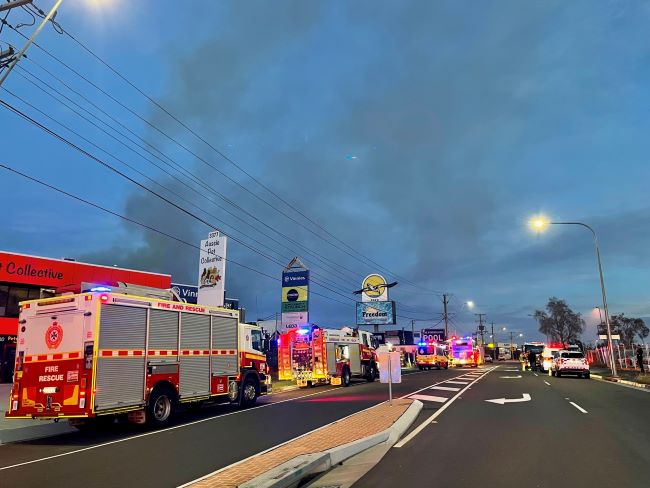
A fire has razed a factory in Slacks Creek less than two months after the factory fire that took the life of firefighter Izabella Nash.
The fire, at a computer store on the corner of Randall St and Kingston Road, broke out around 2am early Wednesday morning, and was attended by 17 fire fighting crews.
Police said they were looking to speak to two men about last week’s fire.
It was a stark reminder of the 2 May blaze just 1km away, where Ms Nash was the first firefighter in 20 years to be killed in duty.
According to a QFES spokesperson, investigations into Ms Nash’s death are ongoing, and her colleague who was injured at the same fire, Lia Drew, is still in recovery.
The latest industrial fire also comes just weeks after a fire in Boronia Heights which destroyed the premises of four businesses.
The fire was declared suspicious and allegedly related to a previous fire at the same place two months earlier in April – also believed by police and fire inspectors to be arson.
Logan, and in particular Slacks Creek, is no stranger to fire tragedy, with 11 people from two families killed in a house fire in 2011.
On that occasion, a fire alarm had been turned off and it remains the worst house fire in Australia’s history.
More recently, the city has recorded 718 residential and 209 non-residential fires in the last five years – an average of more than 185 fires per year.
Ahead of the Logan’s peak fire period in July and August, the Queensland Fire and Emergency Services is releasing key fire-safety tips.
QFES Fire Investigation Unit Manager Daren Mallouk said winter was typically a high-fire period due to a surge in the use of heaters and other electrical appliances.
“The best piece of advice I can give you… is make sure if you’re going to purchase a new heater, purchase it from a reputable retailer,” he said.
“That way you can be sure that they meet all the Australian standards and comply with all the safety requirements.
“If you have any concerns, get it checked by an authorised technician.”
Mr Mallouk said it was the “simple things” that could save a home from destruction.
“Like not putting items too close to heaters,” he said.
“A good rule of thumb is keep things two metres away, but be wary of curtains that may blow across heaters and things that may fall on top of them.
“Don’t leave [heaters] unattended for long periods of time and don’t leave kids around [them] unattended.”
Mr Mallouk also stressed the importance of smoke alarms.
“Smoke alarms are a proven life-savers,” he said.
He said fires escalate “quite quickly” in modern households, so it was crucial to upgrade to the highest standard smoke alarms.
“The earlier the warning, the more chance you have of getting out of the house.”
In the last year alone, Logan has had more than 120 residential fires and almost 50 non-residential fires.
According to Mr Mallouk, firefighters are called to many preventable fires.
He said simple changes could help reduce this, such as not overloading electrical circuits and not leaving food cooking on the stove unattended.
“And don’t over-charge devices,” he said.
He said it was important, especially for young families, to create a fire escape plan.
“Make it a fun activity to practise [for kids].
“This can be used not just for fire, but for other emergencies that may occur in the house.”