


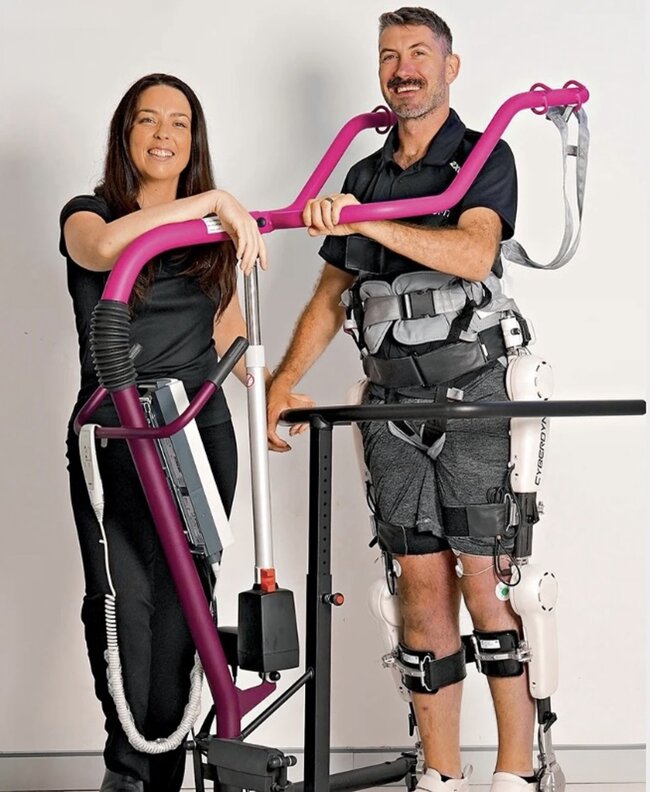
In 2010, Daniel Hillyer suffered a spinal cord injury after a balcony he was standing on collapsed beneath him.
Life as he knew it had changed irrevocably as he adjusted to life with a diagnosis of quadriplegia.
After a 10-month stay in hospital, Mr Hillyer and his wife, Maryanne Harris, who had completed a degree in exercise science, searched for a rigorous and effective rehabilitation program that could give him the best possible results.
Together they travelled the world in search of assistive technology and eventually came across the hybrid assistive limb (HAL), which operates as an exoskeleton from Cyberdyne, a company based in Japan, in 2013.
Over a 21-day trial using the HAL device, Mr Hillyer saw some improvement in his standing balance and gait.
Wearing the HAL device for the first time was “a little bit daunting, initially,” Mr Hillyer said.
“But once I got the hang of it, it felt free-flowing, and it didn’t try and fight me in my walking.
“When I did experience a spasm in my legs on the treadmill, it didn’t try and overpower me and keep stepping; the device would go neutral, wait for that spasm to ride out before resetting.
“It was an amazing feeling to be able to stand up and take independent steps again.”
Mr Hillyer and Ms Harris launched the technology in Australia in April 2021, in Wollongong, New South Wales, after receiving approval for the devices through the Therapeutic Goods Administration (TGA).
Now RoboFit has five clinic locations Australia-wide, including one in Shailer Park.
“Each clinic has two devices, a medium, a large and a backup unit too, so that if one goes down and needs maintenance, we’ve got a unit to continue running sessions with clients,” Mr Hillyer said.
“To date, we’ve helped 451 through the clinics.
“Some people attend the clinic once a week or once a fortnight, but we’ve also got people coming multiple times a week.”
RoboFit run intensive programs as well, which include two-hour sessions five days per week for 12 weeks.
“This device actually works with the weather, not for the wearer,” Mr Hillyer said. “That’s why we fell in love with it.
“It also gave us live data feedback when a patient would wear the device on a treadmill or over ground.”
The device can be used to rehabilitate those who have been diagnosed with conditions like spinal cord injuries, strokes, cerebral palsy, parkinson disease, traumatic brain injuries, multiple sclerosis and functional neurological disorder.
“HAL has two modes, a pre-programmed gait pattern that will walk with someone with a spinal cord injury and is based on weight shifting.
“The other device operates by putting electrodes on the skin of the patient, which pick up biological signals travelling from the brain to the muscle and signal the device to take a step or make a movement.
“That’s shown in real time, which muscles are firing and when through the monitors that we use.”
Mr Hillyer said rehabilitation looks different for everyone and can depend on the nature of an injury. RoboFit assess each client to ensure they are matched to a program that will suit them.
“If when we trial devices with clients and for whatever reason they’re not suitable, we do still offer traditional physiotherapy and exercise physiology services like strength and conditioning,” he said.
“The business was basically designed to say yes to everyone and give them a chance to experience those 1% goals and achieve milestones no matter how little.”
Last week, RoboFit received a grant from the state government’s impact revenue investments funding program, which will grant the organisation up to $200,000.
“The grant’s going to allow us to open our second clinic in Queensland, and that’s only the beginning,” Mr Hillyer said.
In the future, Mr Hillyer hopes RoboFit will expand to 15 clinic locations Australia-wide.
“We received the notification that we were successful in getting the funding last week, so it’s all guns blazing to find and secure a site that’ll be a clinical-based setting similar to what we’ve currently got,” he said.
“We are looking at where to go next, and that’s building a purpose-built health hub where we’ll have a clinical setting and a holistic health hub with accessible accommodation provided as well.”
Image: Maryanne Harris and Daniel Hillyer