


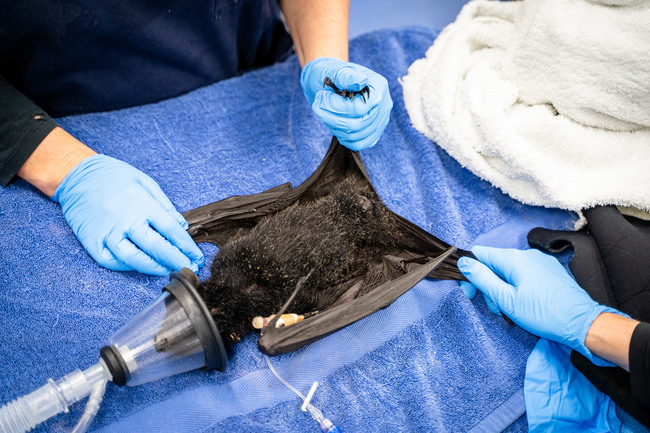
Wildlife workers across Logan are waiting to breathe a sigh of relief as the worst of a deadly paralysis syndrome nears its end.
This summer has proved to be one of the worst in recent history, with hundreds of flying foxes and rainbow lorikeets falling victim to the seasonal disease.
Beenleigh local and secretary of conservation group Bats Queensland, Sonya Sanders, said the number of sick and injured flying foxes was beginning to drop off.
“Today we have had three callouts so far, where in the thick of it we would have had 10-15 by now,” Ms Sanders said at around 11am.
“The numbers have dropped back to almost a normal rescue number at the moment, but with the humidity right now and the rain event we had over the weekend, we are starting to get nervous that we will see it again.”
Not much is known about the illness, but many believe it is transmitted in wet conditions.
In the first two weeks of December last year, Bats Qld rescued 26 flying foxes at camps in Beenleigh and Crestmead.
The year before, there were only six rescues over the entire month.
RSPCA wildlife vets treated 139 lorikeets and 23 flying foxes in the first half of December, which was almost 30% of the total lorikeet intake for the region.
Since then, xxx more lorikeets and xx more flying foxes have been rescued.
“Normally in the Logan area, we would be looking at maybe six rescues for the month, whereas now we are looking at six for the day at the bare minimum,” Ms Sanders said.
“[This] is the first time in such volume – the amount of rescued cases has been creeping up, year-on-year, in the last four or five years.
“We don’t know what it is this season that has produced such a huge spike.”
The Bats Qld team believes access to clean drinking water is likely a contributing factor.
“We are nothing within our camps that if the colony has a water source that is flowing, with access to cleaner water, they seem to be less affected than those with stagnant water.
“The camp at Crestmead is an area with really stagnant water and no drainage around it.”
The sickness stops the animals from being able to fly, walk, blink or swallow.
This means they cannot eat or drink.
According to Wildlife Health Australia, the disease is non-contagious to other species.
While its cause is unknown, an environmental toxin is considered the most likely cause.
Ms Sanders advised locals to be vigilant and on the lookout for sick bats.
“Any bat that is found on its own is generally an alarm bell that it is in trouble,” she said.
“Bats are very social creatures. Even in times of distress they will seek comfort amongst each other.”
Another red flag is bats found below a height of 3m, as they typically perch at much higher levels.
“It is not normal behaviour for a bat to be at that level,” Ms Sanders said.
“If members of the public notice one that is just above head height, we have more of a chance of saving those guys.
“It is the ones that are found on the ground that are a lot more trouble.”
Locals are advised to contact Bats Qld (0447 222 889), Bat Conservation and Rescue Qld (0488 228 134), the RSPCA (264 625), or the nearest wildlife carer, if a sick lorikeet or flying fox is found.
“If you find a sick flying fox, do not touch them,” RSPCA said in a statement.
Are you getting your FREE copy of MyCity Logan?
Simply enter your email address and we’ll ensure a free copy is delivered to your inbox every week.