


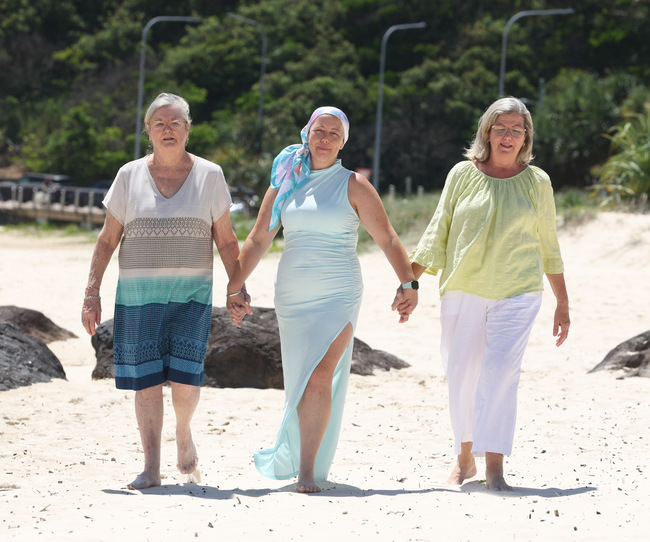
Local mum-of-two Danelle Scalia almost lost it all at age 41 after being hit with a surprise diagnosis – ovarian cancer.
It’s a disease diagnosed in around 1300 women in Australia every year.
And it is one of the most deadly, with a five-year survival rate of 49%.
For Ms Scalia, her chances of developing ovarian cancer were always high because of her family’s history of breast cancer.
Her grandmother, Josephine, was just 48 when she died of breast cancer.
Ms Scalia’s mother, Joanne, and all three of her aunts also fought the disease.
The women all have the BRCA 1 gene mutation, which Ms Scalia has also inherited.
Now, with this month being Ovarian Cancer Awareness Month, she wants others to be aware of the risks.
“I have always been aware of breast cancer and checked myself regularly and had mammograms, but ovarian cancer never crossed my mind,” Ms Scalia said.
“I did consider having genetic testing when I was in my 20s and now I think about what I would have done if I had been more aware of my whole cancer risk.
“I think I would have made different decisions if I had had genetic testing and more knowledge.”
If she could change one thing, Ms Scalia said she would have had her ovaries removed after the birth of her second son..
“If I could go back and change anything, it would have been to take that precaution.”
Ms Scalia was diagnosed following a visit to the GP last September after suffering irregular periods.
Her initial blood and pap smear tests came back clear, she said.
But Ms Scalia “knew something was wrong”, so she demanded an ultrasound scan and further investigation.
Eventually, following a referral to Mater Hospital at South Brisbane, she was diagnosed with stage 3 ovarian cancer, which had spread to her spleen and diaphragm.
Two months later, Ms Scalia underwent a full hysterectomy and removal of her ovaries, spleen and appendix.
She is currently undergoing chemotherapy treatment.
Accoridng to the hospital, women who have the breast cancer (BRCA) 1 and 2 mutations have a 45-85% chance of developing breast cancer, as well as a 10-46% chance of developing ovarian cancer.
Around five per cent of the 20,000 Australian women diagnosed with breast cancer each year have a BRCA gene mutation.
Men with a BRCA gene mutation face an increased risk of prostate cancer.
Senior medical oncologist at Mater’s cancer centre, Dr Catherine Shannon, said most women become aware of their genetic risk when they are tested after they or a family member receive a cancer diagnosis.
“Mater orders genetic testing for all ovarian cancer patients because if there is a genetic link you become eligible for certain treatments, such as PARP inhibitors which specifically target BRCA 1 and 2 cancers,” she said.
“Women whose family members test positive for BRCA 1 or 2 should also consider being tested themselves.
“Depending on the results, they may wish to consider risk reduction surgery. Around 50 to 60 women a year at Mater choose to have their ovaries and fallopian tubes removed in pre-emptive surgery.”
Dr Shannon urged women to know the signs and symptoms of ovarian cancer, which include bloating, pelvic pain and abdominal distention.
“If women experience these symptoms persistently it is important to see a doctor and have them investigated,” she added.