


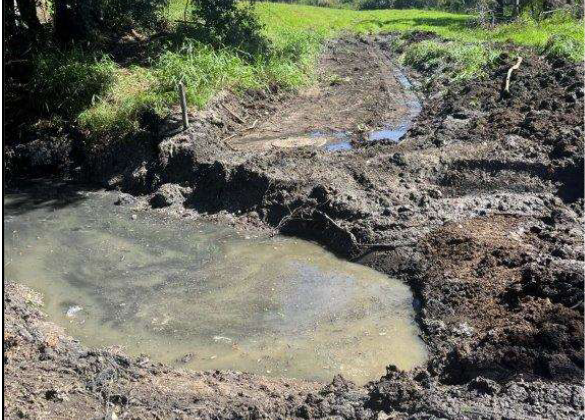
Oxygen in the Albert River was “decreased to extremely low levels” during a catastrophic sewage spill earlier this year.
A Griffith University study has found the three-month, 450-million-litre spill “negatively affected” stationary animals like molluscs and scared away mobile animals like fish.
“Very low dissolved oxygen creates environments where aquatic life cannot be sustained,” the Griffith assessment found.
“Once the spill ceased, dissolved oxygen levels increased quickly.”
However, there has been no evidence of long-term environmental impacts caused by the spill so far.
This is the second report commissioned by Gold Coast City Council to investigate the spill, which leaked around five-million-litres of raw sewage into the Albert River every day for 89 days between January and April.
The pipe that burst runs through Stapylton, Yatala and Ormeau, and into Logan to the Beenleigh wastewater treatment plant.
While the Griffith report looked at the environmental impacts of the spill, Gold Coast council’s first report looked into why the sewer main broke and why the spill went undetected for three months.
It found Logan City Council failed to report “significantly lower flows” that were monitored at the Beenleigh treatment plant.
In July, Logan mayor Jon Raven slammed the report as a “puff piece”.
He said council provided the Gold Coast with all the data Logan had access to.
“In Logan, we have a state-of-the-art water situation room where we can monitor our entire network live,” Cr Raven said.
“And we provide all of that data in real time to the Gold Coast.
“The CEO of the Gold Coast knows exactly what Logan knows, when we know it.”
He said Gold Coast council should wait for the Department of Environment, Science and Innovation (DESI) to complete its investigation.
DESI labelled the spill a “catastrophic failure”.
It is examining the extent of environmental harm “caused by council”, the timeliness of council’s notification of the health risks, and council’s culpability in the management of its sewage collection network.
The department said this could result in enforcement action against Gold Coast council, including a statutory notice and prosecution.
Gold Coast’s acting CEO Alisha Swain has said council was relieved the Albert River had recovered quickly.
“The advice we received at the time was that the significant flows were likely to have diluted the spill, delaying its detection and also lessening environmental impacts,” she said.
“It is a relief this is the case.
“However, we know the low dissolved oxygen in the river as a result of the spill would have impacted immobile animals in the local vicinity.
“We also know that there was a significant failure in our systems, and we remain focused on implementing recommendations from the earlier independent investigation which we released to the public.”
The Griffith University report also found:
- Shore crabs from the lower Albert River sampled after the spill had higher
levels of contaminant accumulation (particularly manganese) than those from upstream of the spill and from the upper Logan River. Contaminant concentrations in shore crabs from the lower Albert River were also higher than in comparable studies in urban estuaries elsewhere in southeast Queensland. The source of these contaminants cannot be explicitly linked to the spill, as there are multiple potential sources of contaminants in the Albert catchment. - Bioaccumulation (the gradual accumulation of substances including chemicals in organisms) of contaminants in shore crabs may be indirectly linked to spilled sewage.
The low dissolved oxygen levels in the lower Albert River during the spill (a result of high organic matter and sulfur loads), could have increased the ability of shore crabs to take up existing metal contaminants in the sediments. - During the spill, nutrient concentrations in the lower Albert River spiked higher, and an
estimated 323 kg/day of additional nitrogen entered the river. The concentration of nitrogen has returned to levels typical for urban impacted river systems. - At this time there is no evidence of an ongoing impact of the spill on nutrient levels, however monitoring will continue.
- Metals were detected in the sediments of the lower Albert River. Mostly this contamination is below guidelines, and likely due to long-term accumulation rather than from the spill.
- The spill contained low concentrations of most PFAS related chemicals. The concentration of PFOS (a type of PFAS) in spilled sewage itself was above the most conservative guidelines for fresh and marine waters, however, after dilution, would have posed a low risk to the environment. Concentrations measured in Albert River sediments were below ambient values recorded in the region.
- Recreationally and commercially valuable fish and mud crabs collected immediately after the spill in the Albert River did not have high concentrations of PFAS chemicals or metal contaminants in their tissues. Concentrations of these contaminants were not significantly higher than comparable data previously collected in 2020.