


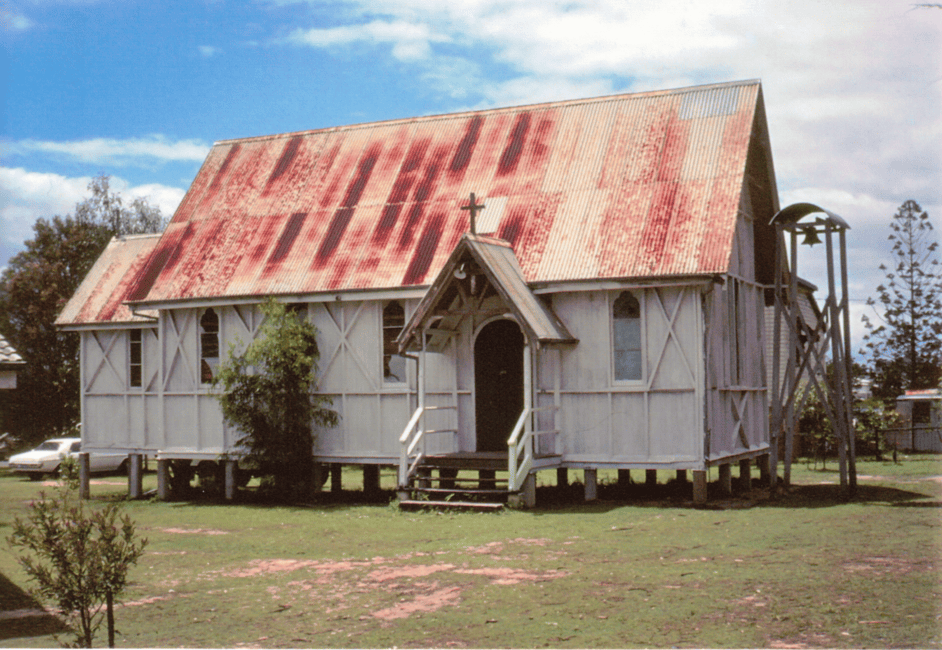
St George’s Anglican Church opened its doors to parishioners and the wider community 150 years ago, in 1875, less than 10 years after the town of Beenleigh was established in 1866.
The church’s original chapel building, made from wood and fitted with a tin roof, was moved to the Beenleigh Historical Village and Museum in 1981 to preserve an important part of area’s history.
Heritage listed by the Queensland government and one of the oldest buildings in Beenleigh, church warden and parish IT officer Peter Farrer said the church was an important piece of local history.
“At the time, Beenleigh was a new settlement, so to speak, and they wanted a centre of worship,” he said.
“Before that, they worshiped in another building that was part of the Beenleigh facilities.”
Colonial Architect Francis Drummond Greville Stanley designed the original church building, one of 200 projects he designed throughout his career and life in Queensland (1861 to 1897), according to the Digital Archives of Queensland Architecture.
Among Mr Stanley’s notable public projects during his employment as Queensland Colonial Architect (1873 to 1881) was the Lighthouse at Lady Elliot Island, where he pioneered the use of local hardwood for construction.
Mr Stanley would use these techniques two years later to construct St George’s Anglican Church with materials including yellowwood, Noosa pine, ironbark, and polished cedar timbers.
A modern brick building was built in 1964 and replaced the historic wooden chapel to make way for new parishioners, as the congregation had grown substantially and needed more room.
“For the size of the congregation, the old church building could not handle it,” Mr Farrar said.
“When the new brick church was put into action, it had been almost 100 years since the previous building was built.”
The block of land where St George was originally built was donated by Michael Tansey, a high-profile local man who owned multiple Beenleigh businesses, including a pub.
A free service at 10am on Saturday, 13 September, will mark St George’s birthday and recognise the milestone, with light refreshments available after the service.
“The service itself will be a mixture of a historical skit from the time [1875] with a lot of children’s involvement, and a mixture of modern worship music that is what we do at St George’s now,” Mr Farrar said.
Church staff have extended the invitation to all community members, including past church members or first-time attendees.
A display of images, documents, and information about the history of the church buildings, the congregation, and parishioner memories is currently on display at the church hall.
Mr Farrar said he thought the faith of parishioners had contributed to the longevity of the church.
“Like any church that is of a Christian denomination, it’s their faith that makes them strong.”