


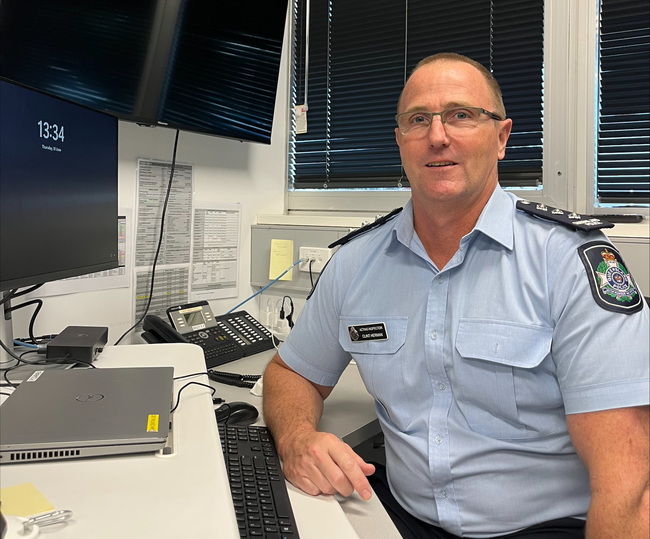
Inside one of Queensland’s busiest police barracks, senior sergeant Clint Herman finishes up a remarkably quiet week.
Between petty crimes and a protest outside the federal treasurer’s office, the officers at Logan Central police station have had their hands full.
Civilians would have said it was a hectic week. But for the officers, it has proven to be one of the cruisiest in years.
“It has been the lowest week for crime in two years,” Mr Herman, the head officer at the station, said on a cold July Friday.
“There seems to be less movement of people in public places when it’s cold – they’re in their houses… maybe the State of Origin helps us.
“But it doesn’t mean the jobs stop.”
When it comes to the number of jobs per officer, Logan Central has historically been one of the worst.
“I don’t know if we have an absolute monopoly, but we’re certainly right at the very top,” Mr Herman said.
“In 2023, Logan Central had the highest reported crimes.”
Officers at Logan Central are mainly called to shop, house and car break-ins, robberies and domestic violence offences.
But earlier this month, things seemed less intense.
It is understood some crimes during this particular July week had reduced by almost 50% when compared to the previous one.
Mr Herman said ideally there would be no crime, but high crime rates could also be swayed by “police generated crime”.
The more police there are keeping a watchful eye over the community, the more crime there is being responded to and therefore crime levels will appear worse – or so the argument goes.
“[High crime rates are] not necessarily bad for the overall well-being of the division or the safety of the community,” Mr Herman said.
“The more resources we have, the higher crime may appear.”
Mr Herman has been a police officer for 30 years, based out of Logan for five, and the officer in charge at Logan Central for nearly two.
Since moving to Logan, he said Covid had one of the biggest impacts on local policing.
“Covid was a game changer. We have seen a continual, persistent increase in demand since we’ve come out of lockdown.”
Another big change was the station’s partnership with the Centre for Women and Co., which has changed the way victims of domestic violence are supported.
“As most people would be aware, we have had a lot of negative attention for domestic violence, unfortunately a very high-profile domestic homicide, and then all those public enquiries,” Mr Herman said.
“One of those recommendations was to embed domestic violence workers in police stations.”
“In a place like Logan, a lot of [victims] don’t have a phone – they don’t have a phone that has credit, or a charged battery, or a phone that is not monitored by their perpetrator – so it is very difficult to get that support to some of these people.
“Now they can come into the station and have access to someone who can connect them to every type of help you can imagine.”
The station’s domestic violence workers will help victims access Centrelink, give them a phone, or organise a locksmith to change their door locks.
The Logan Central police crew is made up of 110 staff, many of whom are fresh out of the academy.
Mr Herman said they were making a difference “one interaction at a time”.