


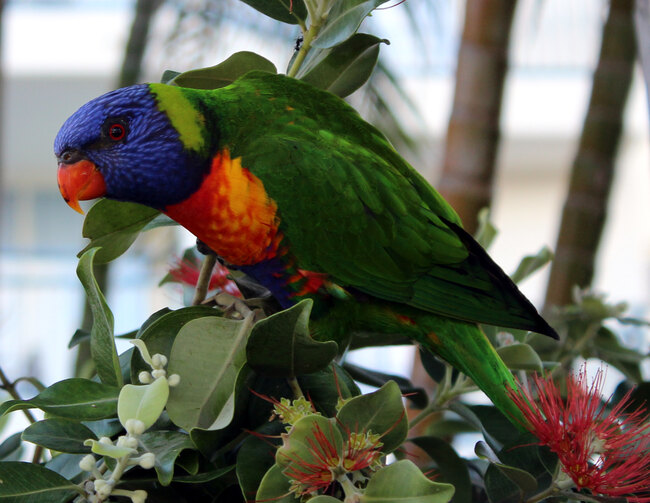
The 10th Aussie Bird Count is in full swing, turning ordinary folks into birdwatching aficionados as they eagerly tally up their feathery neighbours.
In just 20 minutes, you too can become a winged expert and keeping Logan’s wildlife on its toes.
Queensland Ornithologist Scot McPhie said Logan was a diverse area with a variety of birds and habitats.
“The most common bird in your area is actually the Torresian Crow, which is the common crow that most people are familiar with around Southeast Queensland,” Mr McPhie said.
“Followed by the rainbow lorikeet, Australian magpie, noisy minor, magpie-lark, pacific black duck, willie wagtail, brown honeyeater, the laughing kookaburra and the Australian white ibis.
“Almost all of those birds are what we call aggressive generalists, so they’re medium-sized birds that are fairly aggressive in nature and they’ve adapted well to urban environments.”
Mr McPhie said to keep an eye out for the brown honeyeater because, despite its “drab colours”, it was an “extraordinary” bird.
“It’s about twice the size of a sparrow, it’s certainly drab in its colours – it’s kind brown, or olive-green with an elongated beak – but that bird is so loud.
“It’s a bit similar to a noisy minor in the sound it makes, but it will go for a little bit longer and it will be so much louder – you’d think it would be about three times the size.
“That would be the one I would encourage people to look out for.”
An important bird to look out for, Mr Mcphie said, was the endangered glossy black cockatoo.
“These guys are about the pickiest eaters,” he said.
“They have one of the most selective and restrictive diets you can imagine – it’s almost like they’re doing everything they can to become endangered.
“Finding one of them would be a real highlight, and you’ll find them in the more rural areas.”
Mr Mcphie said the bird count would provide a broader insight into native birds, not only because of the number of participants, but because most Australian bird data is based on the study of public urban areas.
“The bird count allows us to get a whole group of people looking for birds who wouldn’t normally do it, so it generates a huge amount of data,” he said.
“We also get it from a lot of private land holdings, like from backyards, and it gives us an idea of what’s going on in urban areas.”
The Aussie Bird Count is from 16 to 22 October.