


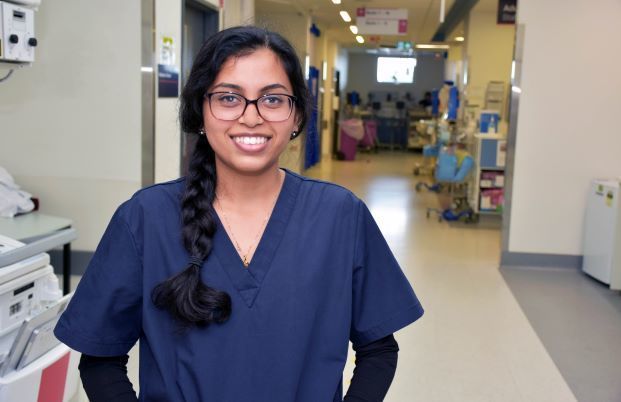
Dr Zarin Nuzhat is well aware of the responsibility being placed on her 25-year-old shoulders.
Driven by her passion for humanity, the Logan Hospital intern has a desire to use her medical knowledge to help people living in poverty in her country of birth, Bangladesh.
“I think that’s why we work so hard at medical school,” she says of the influence she holds with the newly-placed “Dr” in front of her name.
Dr Nuzhat’s father is a doctor and started his Australian career at Logan Hospital where he spent 10 years.
Despite being a shy bookworm who “hated talking to people” as a child, she is now a confident woman and sees herself as an important link in the communication chain.
“I see myself as an interface between the science and medicines, and the patient,” she said.
She’s just three weeks into an internship, but already she draws inspiration from a friend of the family who has a hospital outside Dhaka, the capital of Bangladesh, where he helps poor villagers gain cataract operations.
Dr Nuzhat too, sees herself in emergency care and surgery.
During a visit to Dhaka in 2019, she was disappointed she was unable to do an internship at one of the hospitals there, but her family felt it would be too dangerous.
“It’s not easy for girls to get around,” she said.
“A lot of my family has had no access to education as I have, so I really wanted to be a doctor since high school.”
Now with three years of scientific study and four years of medicine under her belt, the time is right to flourish as a fully-fledged doctor.
Logan Hospital is noted as being a great training ground for doctors where smaller teams gain more hands-on experience than in the larger city hospitals.
For now, the work she does with patients will all be checked by superiors. But it won’t be long before the student becomes the teacher.
Every day, the team starts with a scrum, from where the are dispersed to different disciplines within the hospital.
“Everyone is told that we have to learn. That’s our first priority,” Dr Nuzhat said.
“I spend my nights asking lots of dumb questions, but we’re given the opportunity to be independent when coming up with management plans for patients that are then checked in great detail by experienced medical staff.
“I became a doctor because I want to help people. I know that’s not unusual, but it’s certainly what motivates me.”