


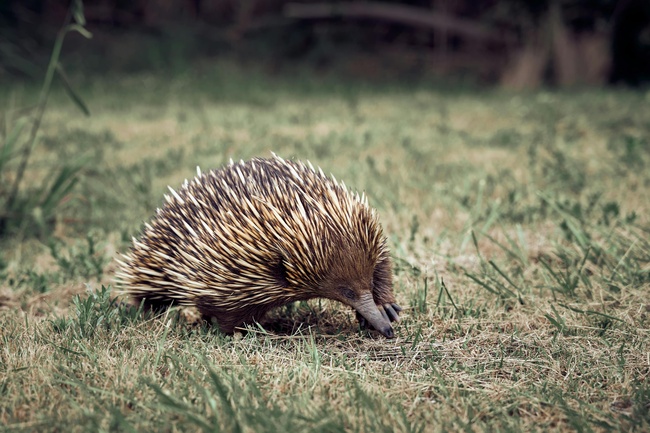
DISCOVERY of a dead echidna on a fire ant nest at Logan Village has prompted national investment in new research.
The research, led by Kate Dutton-Regester from the University of Queensland in partnership with the National Fire Ant Eradication Program (NFAEP), will investigate the impact of fire ants on native species like echidnas and koalas.
Despite fire ants first arriving in the country more than 25 years ago, Dr Dutton-Regester’s research will be a national first.
She said Australia had been relying on data from the United States.
“But our ecosystems and animals are very different. It’s definitely worth doing in our Australian context.”
Her research will focus on how fire ants affect the behaviour, stress levels, and populations of native animals.
It will mean analysing movements to see if wildlife are co-occurring with fire ants, and whether animals like echidnas are trying to eat them.
“We’re particularly interested in whether species that come into contact with fire ants show elevated stress responses, especially koalas, echidnas, and other wildlife already under environmental pressure,” she said.
“This is the first time anyone has studied fire ant presence on wildlife health and behaviour at this scale in Australia.
“What we discover stands to shape future conservations and biosecurity efforts across Australia.”
The dead echidna was found in July this year on the top of a nest in bushland.
An independent toxicologist examination couldn’t prove the echidna was killed by fire ants, which NFAEP said was due to the “advanced state” of decomposition when it was found.
NFAEP said the toxicologist could confirm the echidna’s death was not the result of fire ant eradication treatment.
“There are two possibilities,” Dr Dutton-Regester said.
“Either the echidna was already deceased by some other cause and then the fire ants have come and fed on it like carrion, and they could have developed a nest underneath it. The fire ant team don’t think that’s likely.
“The other option is that the echidna did come and try to feed from [the nest] and then was swarmed and they killed it.”
The impact of the ants, which experts have dubbed one of the most destructive invasive species in the world, is set to be devastating – costing the economy an estimated $2 billion every year and $84 million in environmental damage.
The latest estimates, made by The Australia Institute earlier this year, suggest fire ants could kill around five Logan residents every decade if eradication efforts fail.
The think tank also warned of a $23 million slug to local households every year, with fire ant havoc causing a combined $5 million in medical costs, $4 million in veterinary bills, and $1.3 million in pesticides if we fail to eliminate the invasive pests.
Dr Dutton-Regester’s research is also supported by Griffith University, the University of Adelaide, the Invasive Species Council, UQ’s Ecological Cascades Lab, and the Logan, Ipswich, and Brisbane councils.