


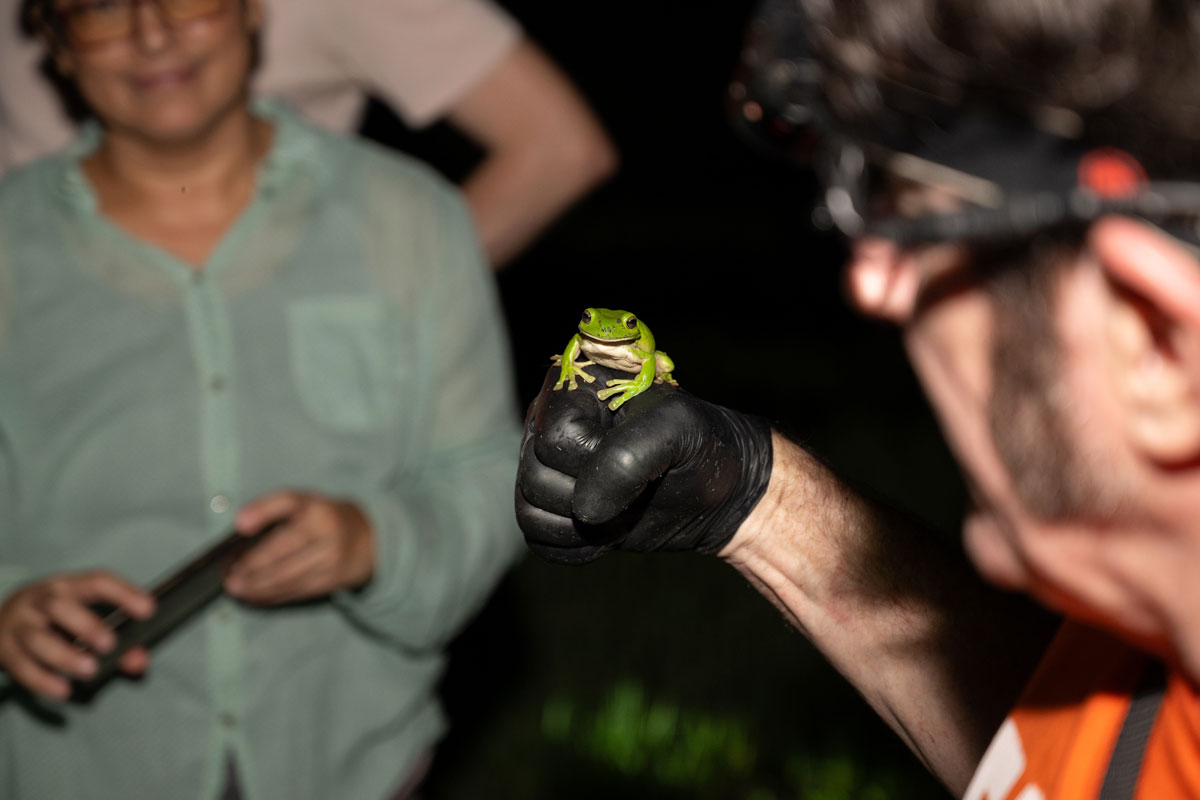
Yarrabilba residents are being urged to take part in Australia’s biggest frog count and encourage the amphibians to live in their backyards.
The Australian Museum is hosting FrogID Week from Friday 6 November to Sunday 15 November and anyone with a phone can help record frog calls through the free FrogID app.
The app can be used to record frog calls anywhere from front yards to local parks to help researchers monitor frog populations and distributions over time.
Yarrabilba resident Aleta Saville, who is an administration officer for environment organisation Watergum, said frogs played important roles in healthy ecosystems by regulating insect populations and being both a food source and an indicator of environmental health.
Ms Saville said this was particularly relevant in Logan where there was a mix of urban neighbourhoods, bushlands, wetlands and waterways that supported a diverse range of wildlife.
“When we protect frog habitat, we also help maintain water quality, native vegetation and the wider network of wildlife that makes Logan such a valuable place for biodiversity,” Ms Saville said.
A Logan City Council spokesperson said 28 species of native frogs had been recorded in Logan, with 12 of these sighted around Yarrabilba, with frogs able to thrive in suburban backyards if conditions were right.
Ms Saville said there were lots of ways residents could make their backyards frog friendly.
“Planting native vegetation, keeping leaf litter and logs for shelter, and reducing pesticide use can all help,” Ms Saville said.
“Building a frog hotel is another great way to provide suitable shelter for some native frog species.”
Wildlife Queensland has a helpful guide to building a frog hotel online.
Ms Saville encouraged residents to learn to identify and manage invasive cane toads.
“Watergum encourages residents to take a consistent, informed approach to cane toad control, including correct identification, safe and humane removal, and the use of tadpole traps to help interrupt their breeding cycle,” Ms Saville said.
She said it was important to correctly identify the frog before taking action, as some native frogs could be mistaken for cane toads, particularly at night.
If residents were unsure, Ms Saville said to take a photo and contact Watergum for identification before removing it.
When homeowners do encounter frogs around their house, Ms Saville encourages them to be mindful.
“Avoid handling them unless necessary, never relocate frogs or tadpoles to another waterbody, and never release aquarium fish or other animals into local waterways.
“These actions help reduce the risk of spreading disease and introducing species that can harm native wildlife,” she said
Ms Saville said you did not need to be a scientist or environmental professional to make a difference.
Making your backyard frog-friendly or learning to identify local species of frogs are valuable steps.
“If more residents take these small actions, we can create a network of wildlife-friendly spaces across Logan, helping frogs move through urban areas and find the resources they need to survive,” Ms Saville said.
Watergum is a not-for-profit organisation that helps the community engage in work to restore, maintain and protect the natural environment.
Its projects extend across south-east Queensland and northern New South Wales.
Logan City Council is encouraging residents to get involved with FrogID Week.
It is hosting events to educate the community about frogs.
Residents can build a frog hotel to provide safe shelter for local tree frogs at a workshop from 9am-10am on Saturday 7 November at Carvers Park, Park Ridge.
Or residents can attend Park after Dark: Frog Spotting from 6.30pm-9pm on Friday 6 November will be a night-time adventure at Forestdale’s Greenwood Lakes.
Bookings are required and can be made through Eventbrite.
Subscribe to stay up-to-date with news from across Logan. You’ll receive a link to our digital newspaper direct to your inbox each week. It’s free.