


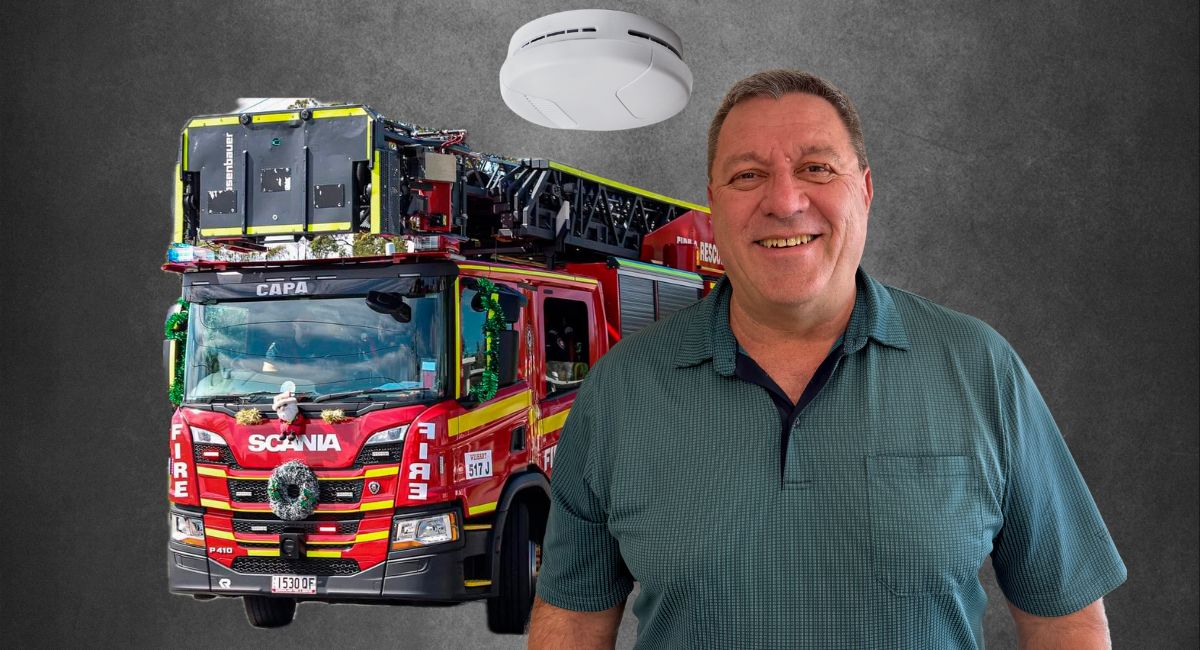
He doesn’t wear a cape, or even a uniform, but when police and firefighters need help, they call Louie Naumovski.
In those first moments after a house fire, when the air is filled with smoke, the ground is smouldering and the firefighters are finishing up, Mr Naumovski provides calm, practical help.
“When you show up to a fire, people have got nothing but the clothes they’re wearing. Sometimes they’re in their pyjamas because house fires often happen at night,” Mr Naumovski said.
He spent more than a decade helping people after losing someone in a house fire. It’s a role he never expected and one he can’t quite seem to leave behind.
“I was a used car salesman for 20 years,” Mr Naumovski said.
He lived not far from Slacks Creek, where 11 people died in what’s become known as Australia’s worst house fire.
In the early hours of Wednesday 24 August, 2011, three adults and eight children died in the Wagensveldt Street home where two close-knit Samoan-Tongan families had lived together.
Mr Naumovski and his then-wife Christine drove past the home and stopped to pay their respects to survivor Tau Tafou, who was sleeping in a tent in the front yard.
“I just wanted to offer my condolences. I had $50 in my wallet and I gave him $50 and drove away,” Mr Naumovski said.
“I couldn’t believe I’d just told him the loss of his family members was worth $50.”
He felt compelled to do more.
Mr Naumovski helped raise money to cover the costs of burying the family.
He supported Mr Tafou through the inquiry that followed. They became friends.
“That changed the rest of my life,” Mr Naumovski said.
There were more fires. Informally, Mr Naumovski became the person emergency services called when families needed practical help – whether it was a change of clothes, a lift to a friend’s house or emergency accommodation if there was nowhere else for them to go.
By 2014, Mr Naumovski had founded the Logan House Fire Support Network charity and drove a van to transport donated items to people who had lost everything.
He helped arrange more funerals and ongoing counselling.
He saw firsthand the devastating impacts house fires had on people and wanted to stop it.
He talked to firefighters and learnt about how smoke alarms worked and why what Queensland was doing in 2011 wasn’t good enough.
At the time, Queensland laws required homes to have smoke alarms, but people could choose the cheaper ionisation alarms, which took too long to detect a deadly smouldering fire but would sound a false alarm for burnt toast or shower steam.
At the inquest into the Slacks Creek fire, coroner James McDougall recommended photoelectric smoke alarms be installed in every bedroom because they were more effective at detecting fires.
He advised they should be interconnected so if one alarmed, it warned everyone in the house.
He also recommended people have well-practiced escape plans, because fires can engulf a home surprisingly quickly.
Mr Naumovski lobbied politicians.
The State Government ran an awareness campaign, but people kept dying in house fires.
Mr Naumovski spoke at a Senate committee hearing into smoke alarms in 2015.
He was angry.
He’d just helped families bury four people in four months, including a Beenleigh boy who died in a house fire on his second birthday.
Mr Naumovski had been there to support the families.
He’d seen the impact the deaths had on the firefighters, police officers and paramedics who were first on the scene.
“We were pushing for education and awareness and we would put out our own safety warnings,” he said.
In 2016, the Queensland Government passed law mandating photoelectric smoke alarms in every bedroom and storey of every home in a three-stage roll out over 10 years.
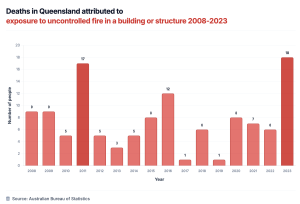
Australian Bureau of Statistics figures show the number of deaths in a building or structure (including house fires) dropped to an average of just under five deaths a year from 2017 to 2022 in Queensland.
But in 2023, 18 Queenslanders died in buildings or structures, including six people in a rental home where the owner was later reportedly fined for not installing compliant smoke alarms.
More recent figures have not yet been published.
Mr Naumovski said the horror of house fire deaths reached beyond the survivors to emergency service workers who were the first to respond.
He wanted to bring joy to those who saw so much tragedy in their everyday jobs, so he started the Logan Emergency Services Santa Run.
Every year on Christmas Day, a convoy of cars and trucks loaded with donated presents rolls out of Woodridge Fire Station and winds its way through Logan before ending at Logan Hospital.
Families line the streets, waving to the firefighters, police and paramedics as they hand out presents.
“It brings so much joy to so many,” Mr Naumovski said.
Even though Mr Naumovski closed his fire support charity in 2023, when cancer meant he had to have half his lung removed, he’s still involved.
He helped a Kingston family set up a GoFundMe to cover funeral costs after a fire in July, he’s about to ramp up collections for this year’s Santa run, and he recently climbed 41 flights of stairs to raise money and awareness for the Firefighters Cancer Foundation Australia.
Maybe he should get one of those capes.
Subscribe to stay up-to-date with news from across Logan. You’ll receive a link to our digital newspaper direct to your inbox each week. It’s free.