


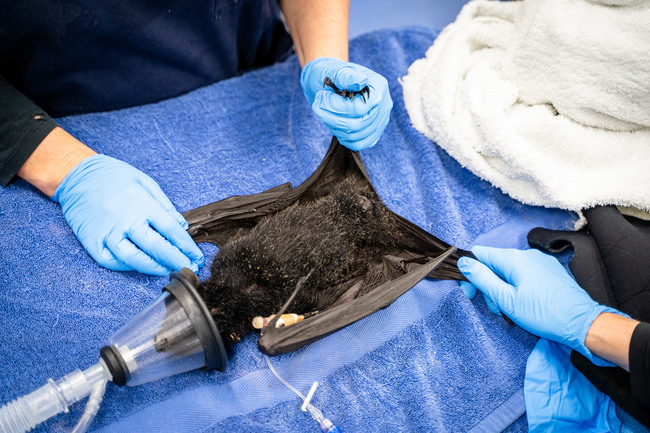
Rainbow lorikeets and flying foxes are dropping like flies as a deadly disease causing paralysis spreads across Logan.
Cases of Lorikeet Paralysis Syndrome (LPS), which also impacts flying foxes, are rising across the south-east corner of Queensland.
In Logan, RSPCA Queensland wildlife vets have treated 139 lorikeets and 23 flying foxes since 1 December this year.
That is 29% of RSPCA’s total lorikeet intake for the region.
In that same time, vets treated 104 flying foxes across the region.
More than 40 new sick lorikeets are being treated every day.
The RSPCA Hospital in Brisbane claims to be inundated with patients, and has called on the community to help out.
“Unfortunately, we are at capacity today with flying foxes suffering from paralysis syndrome,” RSPCA wildlife veterinary director Tim Portas said.
“We’re working with Bats Conservation and Rescue QLD, our wildlife carers, along with the SEQ Hospital Network which includes Currumbin Wildlife Hospital and Australia Zoo to ensure affected flying foxes can get expert care where resources are available.”
The RSPCA is not the only busy organisation, with the teams at Bat Conservation and Rescue QLD and Bats Qld working day and night to save sick flying foxes.
They say the numbers are rising.
Bat Conservation and Rescue QLD president Mel Brennan said her team had rescued hundreds of bats, with 145 flying-fox adults and 170 orphans currently in their care.
Bats Qld secretary Sonya Sanders said her team was also working tirelessly at flying fox colonies, where they had set up emergency response trailers to help triage patients.
“Our carers are denying themselves sleep so they can take care of the sick and orphaned at home – many of our Gold Coast carers have Logan animals in care; and members of our management committee are working closely with the Logan City Council Parks as well as Waste Management teams to come up with a strategic plan to manage this unprecedented event,” she said.
Since the start of the year, 5821 lorikeets have come into the RSPCA’s care, with up to 200 new birds entering the Wildlife Hospital daily in January and February.
“Flying foxes were also affected earlier this year, but not the volume we’re seeing currently which is putting pressure on our team to find resources and space to accommodate them,” Dr Portas said.
LPS stops the animals from being able to fly, walk, blink or swallow.
This means they cannot eat or drink.
According to Widlife Health Australia, the disease is non-contagious to other species and its cause is unknown.
However, an environmental toxin is considered the most likely cause.
Ms Brennan said lorikeets and flying-foxes eat similar foods.
“… so we suspect it is something in the environment,” she said.
“We see paralysis after rain and warm weather at this time of year however we don’t know what is causing it.
“The scientific community has been researching however no known cause has been identified yet.
“Unfortunately, we don’t know why it is so bad this year.”
The disease is treatable when found early, but requires weeks of intensive care.
Locals should contact the RSPCA, Bat Conservation and Rescue Qld (0488 228 134) or Bats Qld (0447 222 889), or the nearest wildlife carer, if a sick lorikeet or flying fox is found.
“If you find a sick flying fox, do not touch them,” RSPCA said in a statement.
“If you find a sick lorikeet you can transport them to your nearest vet for triage in a box with ventilation and a towel.”
Are you getting your FREE copy of MyCity Logan?
Simply enter your email address and we’ll ensure a free copy is delivered to your inbox every week.